Early or late, a train that leaves "not on time" is unacceptable in Japan.


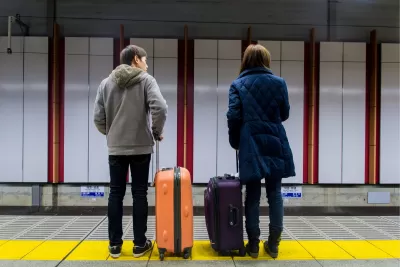
"Living up to Japan’s reputation for being precise as well as contrite, a train company in Tokyo delivered a formal apology on Tuesday because one of its trains left a station just 20 seconds early," report Motoko Rich and Makiko Inque.
The Metropolitan Intercity Railway Company "posted an apology on its website Tuesday for 'the severe inconvenience imposed upon our customers,'" adds the article. The offending train: the No. 5255 Tsukuba Express train leaving Minami-Nagareyama station in Chiba. The train left at 9:44:20 am, instead of the scheduled departure time of 9:44:40 am.
Rich and Inque don't miss the opportunity to survey the response of transit users in other countries, where less precise systems operate. Twitter was very generous in revealing the envy of transit users. SFGate and BBC News also got in on the fun, reporting the news and finding plenty of social media commentary to wash it down.
Read the full story: Japanese Train Leaves 20 Seconds Early. Cue the Abject Apologies.

A Citizen-Led Plan Would Revamp Salt Lake’s Transit and Freeway Mix
The Rio Grande Plan would restore rail service to the Rio Grande Depot and reconnect a community divided by a freeway in Salt Lake City.
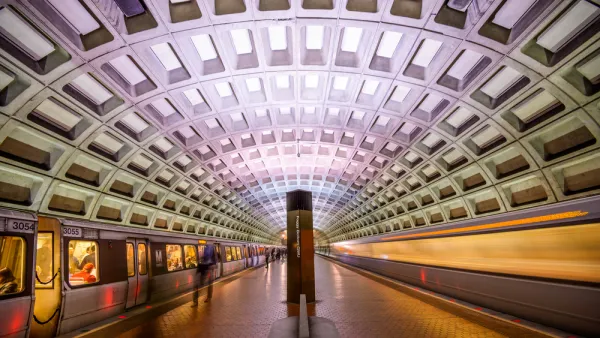
Showdown Over Late Night Hours on D.C. Metro
The general manager of D.C. Metro wants to extend limited late night rail service, in place for two years, into 2019 and beyond. Metro board members have had enough.
Sunday Fun: Take a Google Earth Flyover Tour of Tokyo's Yamanote Line
A key ring route in Tokyo's massive collection of rail lines, the JR Yamanote Line is a public transit aficionado's wildest dream. Reece Martin offers a guided tour of the line, available from the comfort of any YouTube-enabled screen.

Planetizen Federal Action Tracker
A weekly monitor of how Trump’s orders and actions are impacting planners and planning in America.

California plans to bury El Niño’s downpour
If the state plays its cards right, it may be able to store a billion acre-feet of El Niño’s water in aquifers.

Desperate measures: Advocates weigh draining Lake Powell to fill Colorado River
Draining the reservoir could reduce evaporation losses by a couple hundred thousand acre-feet.

Mamdani’s pied-à-terre tax survives legal challenge
A panel of judges found that the plaintiffs failed to demonstrate injury as a result of New York City's implementation of the tax.

Eastern Nebraska is running out of electricity
Data centers and electrification are straining eastern Nebraska’s grid, throttling economic development.

Seattle passes record-breaking transit services expansion
Proposition 1 will double the city’s transit tax to add 95,000 more bus trips and preserve 180,000 bus trips annually.

FREE Course: Walkable City 1: Why Walkability?
After describing his path towards focusing on walkability as the essence of good planning, Jeff Speck marches through his five principal reasons for making more walkable places.
Reinventing Malls: Planning Alchemy—Turning Gray Fields Into Gold
The course focuses on the opportunities and imperatives that shape reinvention of mall sites.

City of Rosemead
Rutgers University, Edward J. Bloustein School of Planning and Public Policy
One Hundred Miles
Hunter College, City University of New York (CUNY)
The Architects Foundation
University of Cincinnati Online
City of Cambridge
Montrose County
The Pocatello Development Authority