Bodegas play an essential role in the communities they serve. Under threat by online retail and encroaching chain stores, they face a new danger from technology. New York YIMBY gives them a well-deserved shout-out.


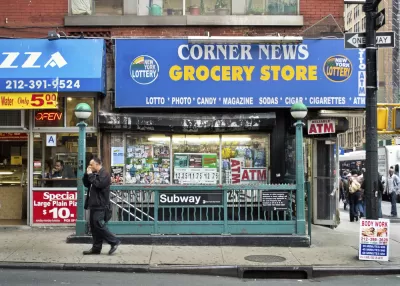
Urbanist Jane Jacobs is credited with developing the concept, “eyes on the street," to describe how vibrant urban neighborhoods, complete with "a healthy neighborhood retail scene," make for safer places to live, writes Nikolai Fedak for New York YIMBY.
With storefronts and their occupants keeping vigilant over an area, criminal activity is deterred, while the pedestrian experience is substantially improved. The concept is not difficult to understand.
In this regard, the local bodega is perhaps one of the most valuable assets New York City real estate has to offer. Besides the aspect of convenience that the neighborhood stores provide, many are also open 24 hours a day (or close to it), providing a spot for local characters to congregate alongside store owners and shop workers.
The sum of this activity plays an immeasurable role in ensuring that peripheral neighborhoods generally lacking in retail still have spots that light up the nighttime streets, and eyes to watch them.
With that introduction, Fedak points to the latest threat from Silicon Valley, the automated bodega. Two years ago it was expanding chain stores, and now these independent mom and pop stores are threatened by even smaller retail outlets.
A campaign against the new startup has been launched by the Association for Neighborhood and Housing Development, "the umbrella organization of 100 non-profit affordable housing and economic development groups, serving low- and moderate income residents in all five boroughs of New York City." The association calls the vending machine outlets "brodegas".
As New York State Coalition of Hispanic Chamber of Commerce Chairman Frank Garcia said, “Real bodegas are all about human relationships within a community.”
Considering the public safety element of bodegas and the importance to neighborhoods not served by larger retail establishments, Fedak recognizes "the unquantifiable gap in quality of living that is likely to result if bodegas do begin to close en-masse."
Though exact numbers are impossible to quantify, the social value of these specific mom & pop retail stores is vastly greater than the material goods within.
Zoning woes
However, as with so many things urban, the problem posed by the new startup can be connected to zoning, which is why brodegas may literally be replacing bodegas rather than occupying new retail space, which Fedak explains is "actually impossible" in many neighborhoods.
Instead of focusing on why “Brodega” is a terrible idea, there needs to be comprehensive reform of where retail can and cannot be built, or the likelihood that bodegas and the rest of the five boroughs’ mom & pop retail scene go the way of the dinosaurs is going to increase substantially.
Read the full story: Why Bodegas Are Crucial To The Continued Success Of New York City Real Estate

What Actually Got Built Under Eric Adams’ ‘Pro-Housing’ Administration
The outgoing mayor claims credit for hundreds of thousands of new homes. The truth is more complicated.
Staten Island Resists ‘City of Yes’ Zoning Reforms
One year after New York City approved major zoning changes, some residents continue to fight increased density.
Upzoning Could Bring 15K New Homes to Queens
A rezoning plan for Long Island City opens up prime waterfront land for residential development, but some critics say new housing could be prone to flooding and should be built farther inland.

Planetizen Federal Action Tracker
A weekly monitor of how Trump’s orders and actions are impacting planners and planning in America.

‘Going backwards:’ Baltimore mayor, students rally against state's transit funding plan
Maryland's proposed six-year plan provides no funding for Baltimore’s BMORE bus program and reduces its road maintenance funding.

Detroit to transform waterfront with $2.2 billion investment
Developers will convert about 18 acres of unused parking lot space into civic spaces.

25 states, cities sue the EPA over erased power plant emissions limits
The coalition also intends to sue the EPA for not regulating emissions from gas-fired power plants.

Newsom vetoes giving CA tribes greater voice in water projects
In his veto letter, Newsom said the bill would add ‘uncertainty’ to the state’s fight to secure Californians’ water supplies.

Michigan Senate votes to revise 'lax' dam safety laws
A Bridge Michigan investigation found more than 100,000 Michigan residents live in the floodpath of a high or significant-hazard dam.

FREE Course: Walkable City 1: Why Walkability?
After describing his path towards focusing on walkability as the essence of good planning, Jeff Speck marches through his five principal reasons for making more walkable places.
Reinventing Malls: Planning Alchemy—Turning Gray Fields Into Gold
The course focuses on the opportunities and imperatives that shape reinvention of mall sites.

City of Thousand Oaks
City of Wisconsin Rapids
Harvard University Graduate School of Design
The Architects Foundation
University of Cincinnati Online
Northern Illinois Transit Authority (NITA)
The Pocatello Development Authority
The Urban Renewal Agency of the City of Pocatello