Mountain View, located in the heart of the Silicon Valley, has commissioned and completed a study into the deployment of automated guideway transportation on two primary corridors.


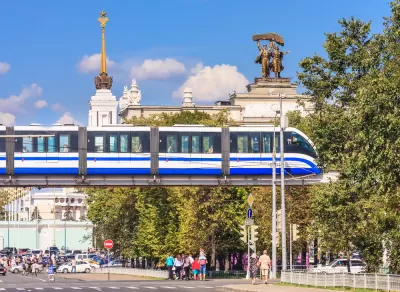
John Orr reports that the city of Mountain View is considering an "automated guideway transportation" (AGT) proposal to ease traffic congestion "between North Bayshore and the city’s transit hub at Castro Street and Central Expressway."
"AGT might be part of a 'solution to improve the last-mile connectivity and other mobility challenges,'" according to a recently completed study.
The AGT idea is described as similar to transportation technology already found at airports, and "might be a way around adding road capacity, which 'is neither practical nor preferred to address the increasing traffic congestion that undermines the continued economic growth and vitality of the city,'" according to the study.
"The study, run by Jim Lightbody of the firm Nelson/Nygaard in San Francisco, is looking at several forms of transportation, from self-guided electric buses running on rubber tires to monorail systems and even elevated cable cars," adds Orr.
Orr cites the city’s public works director, Mike Fuller, who says two corridors are under discussion. The "Mountain View Automated Guideway Transportation Feasibility Study" is available online.
Read the full story: Mountain View studying automated transit system
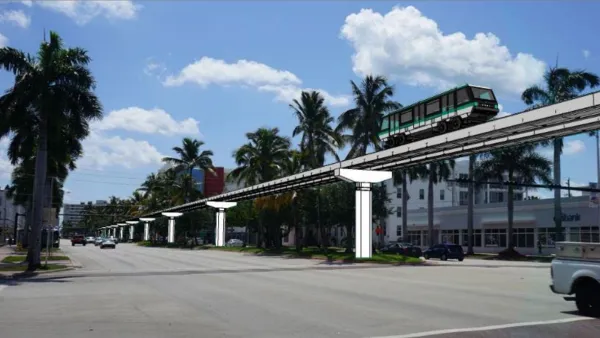
Miami Rapid Transit Project Moves Forward
The county completed the draft environmental impact study for a monorail and people mover planned as part of its rapid transit system.
The Time the Google Self-Driving Car Got Pulled Over for Driving Too Slowly
Google's response to its self-driving car getting pulled over by police in California: " "Driving too slowly? Bet humans don't get pulled over for that too often."
L.A. Surprising History of Transit Innovation
In recent years, Los Angeles has embraced mass transit as a solution to the city's legendary traffic woes. This embrace has historical precedent, however, says Sam Lubell, who examines six of L.A.'s unbuilt proposals for transit systems.

Planetizen Federal Action Tracker
A weekly monitor of how Trump’s orders and actions are impacting planners and planning in America.

California plans to bury El Niño’s downpour
If the state plays its cards right, it may be able to store a billion acre-feet of El Niño’s water in aquifers.

Desperate measures: Advocates weigh draining Lake Powell to fill Colorado River
Draining the reservoir could reduce evaporation losses by a couple hundred thousand acre-feet.

Mamdani’s pied-à-terre tax survives legal challenge
A panel of judges found that the plaintiffs failed to demonstrate injury as a result of New York City's implementation of the tax.

Eastern Nebraska is running out of electricity
Data centers and electrification are straining eastern Nebraska’s grid, throttling economic development.

Seattle passes record-breaking transit services expansion
Proposition 1 will double the city’s transit tax to add 95,000 more bus trips and preserve 180,000 bus trips annually.

FREE Course: Walkable City 1: Why Walkability?
After describing his path towards focusing on walkability as the essence of good planning, Jeff Speck marches through his five principal reasons for making more walkable places.
Reinventing Malls: Planning Alchemy—Turning Gray Fields Into Gold
The course focuses on the opportunities and imperatives that shape reinvention of mall sites.

City of Rosemead
Rutgers University, Edward J. Bloustein School of Planning and Public Policy
One Hundred Miles
University of Michigan School for Environment and Sustainability (SEAS)
Hunter College, City University of New York (CUNY)
The Architects Foundation
City of Cambridge
Montrose County
The Pocatello Development Authority