Having charged low rates during years of bumper development, the National Flood Insurance Program worked at cross-purposes with itself while development continued on.


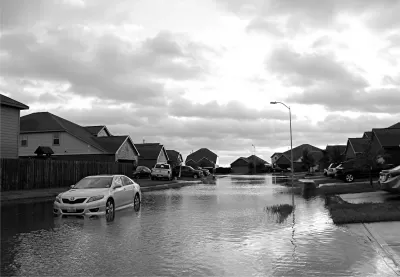
Drawing from a segment of Vox's "The Weeds," Kelly Swanson writes, "The national flood insurance program was created in the 1960s to deter people from building in flood prone areas. But, says Sarah [Kliff], it has actually done the opposite."
"[Matthew Yglesias] offers an explanation as to why representatives from flood-prone areas support the federal flood insurance program — the cheap land has promoted economic growth." Charging low premiums in what were actually high-risk areas did little to curtail development there. And when the floods came, money was available to bail the most risky homes out.
Eager for development, local politicians supported the program. Says Yglesias, "It was the politicians in these areas that did not really want to accept the market verdict, that it may seem like the city of Houston is surrounded by cheap land, but that land has enormous hidden flooding risk."
Read the full story: The Weeds: the problem with the national flood insurance program


Post-Harvey Homeowners Face an 'Army of Speculators'
In Houston, investors are snapping up damaged homes that will be dependent on flood insurance.
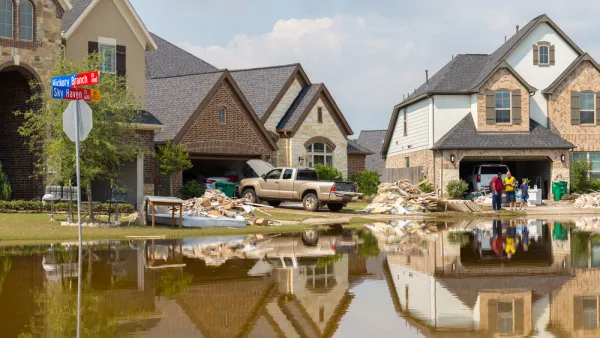
Hurricane Harvey and the Failure of the National Flood Insurance Program
Houston's most recent natural disaster is only the latest example of how a program created to help homeowners has been a greater benefit to the industries that profit from them.
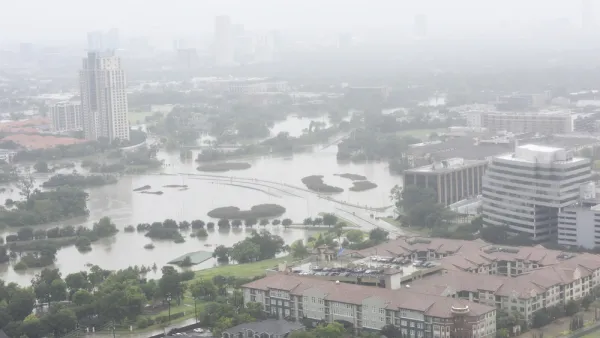
Harvey Flooding Unlikely to Depress Houston's Housing Market
Vigorous continued demand for Houston homes left some realtors surprised after the city endured catastrophic flooding. For a lot of new construction, elevated homes may become the norm.

Planetizen Federal Action Tracker
A weekly monitor of how Trump’s orders and actions are impacting planners and planning in America.

Amtrak, CN end decades-long dispute with eight-year agreement
The new operating agreement establishes an updated framework for the companies to work together, including processes to resolve disputes.

Judges permit Denver to divert 77,000 acre feet from the Colorado River for reservoir expansion
Overuse and climate change have caused the Colorado River’s water levels to plummet.

NYC DOT wants faster, more permanent street upgrades
The city is examining ways to build more concrete infrastructure without getting entangled in 'decades-long' projects.

'Something we’ve never seen before:' rising utility rates could strain city finances nationwide
Data centers, climate change and other factors have caused utility rates in the United States to increase by 38% since 2020.

Trump to overrule local leaders, lease millions of acres of America’s Pacific Island territories’ seafloors to mining companies
International law says that the Indigenous people of America’s territories have a right to prior and informed consent regarding projects that impact their countries.

FREE Course: Walkable City 1: Why Walkability?
After describing his path towards focusing on walkability as the essence of good planning, Jeff Speck marches through his five principal reasons for making more walkable places.
Reinventing Malls: Planning Alchemy—Turning Gray Fields Into Gold
The course focuses on the opportunities and imperatives that shape reinvention of mall sites.

Harvard University Graduate School of Design
KFH Group Inc.
Greater Baltimore Committee
The Architects Foundation
University of Cincinnati Online
The Pocatello Development Authority
The Urban Renewal Agency of the City of Pocatello