People say they're more confident that their lost wallets would be returned or that they would meet a friend on a corner that had a rainbow-painted crosswalk.


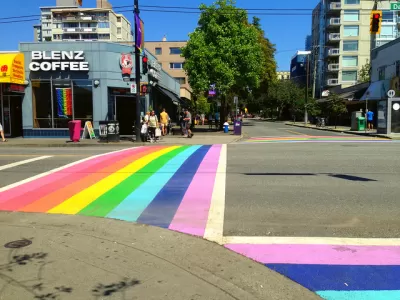
Charles Montgomery, author of Happy City and head of a consultancy with the same name, wanted to look into the way environments influence trust, isolation, and attitudes toward strangers. In researching these social topics, Montgomery led a study that involved a hundred participants, gauging their reactions to different locations in Vancouver. They were particularly struck by the response their subjects had to a corner with a rainbow crosswalk.
These crosswalks are a feature of Vancouver's Davie Village neighborhood. "[I]n 2012 the city’s road crews painted over the four standard zebra crosswalks at an intersection in the heart of the village with fat, bright, rainbow-colored bands. The move was so popular that they made the change permanent the following year and turned an adjoining side street into a rainbow-flecked public plaza," Montgomery writes for Quartz.
The study included a number of tests and questions: "We used games to test concentration and generosity. But people’s answers to standard survey questions told the most powerful story: They showed that the city’s tactical interventions made a huge difference to people’s feelings and attitudes," Montgomery reports.
FULL STORY: Rainbow-painted crosswalks can boost trust among strangers

Guerilla Urbanism Spurs Action From Cities
Rather than take a hostile approach to DIY urbanism, some cities are using guerilla efforts as an opportunity to understand critical infrastructure gaps.
Guerilla Urbanism: Small Interventions, Big Impact
Citizen-led projects can lead to broader changes — if cities will listen.
Tactical Urbanism Makes Strides in L.A.
A DIY urbanism group in Los Angeles has successfully prompted the city to install permanent crosswalks at dangerous intersections, despite the city’s insistence that the group’s do-it-yourself work is illegal.

Planetizen Federal Action Tracker
A weekly monitor of how Trump’s orders and actions are impacting planners and planning in America.

The state-sanctioned urbicide of Austin
People don’t kill cities. Freeways do.

US to reduce Colorado River water deliveries to Mexico
A new Colorado Treaty amendment reduces Mexico’s Colorado River water allocation by 250,000 acre feet.

5 New England states march closer to 800 megawatt wind energy project
Securing federal approval for the project may be complicated under the Trump administration, which has historically been hostile towards domestic wind power.

Baltimore to break ground on $50 million Transit Priority Project
The project will bring faster bus trips, safer streets and better bike connections to Baltimore.

Airbnb launches $250 million 'last-dollar financing' housing accelerator, makes first investment in Austin
The company will put $6.4 million towards affordable housing development in Texas’ capital.

FREE Course: Walkable City 1: Why Walkability?
After describing his path towards focusing on walkability as the essence of good planning, Jeff Speck marches through his five principal reasons for making more walkable places.
Reinventing Malls: Planning Alchemy—Turning Gray Fields Into Gold
The course focuses on the opportunities and imperatives that shape reinvention of mall sites.

Eagle County Government
Harvard University Graduate School of Design
Nashville Planning Department
The Architects Foundation
University of Cincinnati Online
The Pocatello Development Authority
The Urban Renewal Agency of the City of Pocatello
Journal of the American Planning Association