A free camp for young people in Brooklyn is teaching kids to appreciate the science and art of planning.


Jackie Snow reports on the proceedings at the Science of Smart Cities (SoSC) program at the NYU Tandon School of Engineering’s Center for K-12 STEM Education.
On a recent August afternoon in Brooklyn, dozens of summer camp students swarmed around cities of their own creation. Sure, they were mostly built out of Legos, small sensors and cardboard, but they were thoughtfully laid out with carefully designed infrastructure. One such city was Meracia, a name that is less exotic than first appearance.
Meracia (America with the words scrambled) was built by Elizabeth, a 12-year-old. "Elizabeth explained that Meracia was built in the shape of a hexagon so everything can be equally distributed," explains Snow. "The solar panels were built with sensors and motors that can actually move to get more sun, and three main Wi-Fi towers triangulated around the city’s downtown hub with smaller towers to fill out the rest of the city."
The article includes a lot more detail on the agenda and goals of the SoSC program, which is the first of its kind in the country but has already attracted at least one imitator.
Read the full story: At this NYC summer camp, kids build dream cities from scratch
Innovative Programs to Teach Planning to Young People
An exhibit at the National Building Museum showcases the work of teens in city planning and design. It's just one recent example of innovative programs to get youth involved in the process of engaging with their communities.
Everything you Need to Know from the APA’s 2026 Trend Report for Planners
Plus, a conversation with the APA’s Chief Foresight and Knowledge Officer, Petra Hurtado.
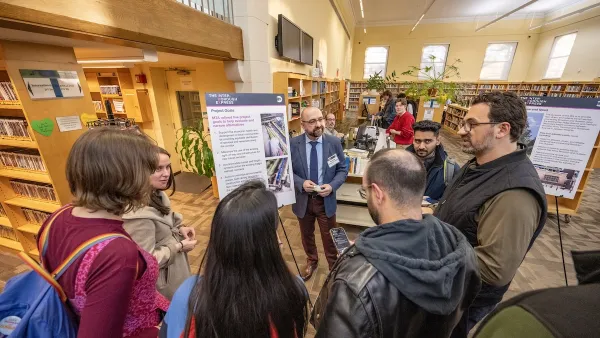
Will Urban Planners Lose Their Jobs to AI?
Let’s see what the data says.

Planetizen Federal Action Tracker
A weekly monitor of how Trump’s orders and actions are impacting planners and planning in America.

Washington state to charge fee to drivers with fuel-efficient cars
Revenue from the fee will go towards supporting the state’s highways.

Illinois considers spending $1 billion in taxpayer money on data center
A quantum computing campus and data center are currently under construction in Chicago.

Did data centers change how voters cast their ballots?
Texas, Ohio, and Georgia all flipped party control. But in rural counties, the effect of local data centers was mixed.

Amtrak invests in eight new Airo trainsets
The new trainsets will begin serving passengers in 2031.

HUD to end aid for mixed-immigration-status households
The new rule is projected to impact 80,000 people, nearly half of whom are children.

FREE Course: Walkable City 1: Why Walkability?
After describing his path towards focusing on walkability as the essence of good planning, Jeff Speck marches through his five principal reasons for making more walkable places.
Reinventing Malls: Planning Alchemy—Turning Gray Fields Into Gold
The course focuses on the opportunities and imperatives that shape reinvention of mall sites.

City of Charlotte
City of Rosemead
Rutgers University, Edward J. Bloustein School of Planning and Public Policy
University of Michigan School for Environment and Sustainability (SEAS)
Hunter College, City University of New York (CUNY)
The Architects Foundation
University District Partnership