Look no further than the American Southwest for signs that human ingenuity is no match for the ability of the planet to reassert its power.


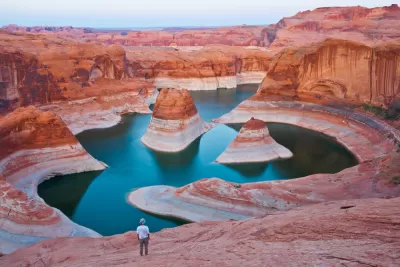
Kate Wheeling writes of five examples—"landmarks," as they're described in the story—of the limits of engineering to control the environment. The story's introduction explains the stakes of the natural and human-built systems in question:
The American West is a testament to hubris. We beat back the desert with a complex plumbing system of dams, canals, and pumps to create a thriving civilization in the hottest and driest region of the country. But today it's becoming clear that many of the structures built to prevent a shortage of water have ultimately contributed to its scarcity. And, now, even as we try to come up with new ways to engineer the environment in our favor, the desert is pushing back into its former territory.
Wheeling lists Glen Canyon Dam, which dams the Colorado River in northern Arizona, the Navajo Generating Station, the Navajo Sand Dunes, Biosphere 2, and the Agua Caliente Solar Facility.
The article is supplemented with striking images by Mark Powers of Magnum Photos.
Read the full story: WHEN THE DESERT PUSHES BACK AGAINST HUMAN ENGINEERING
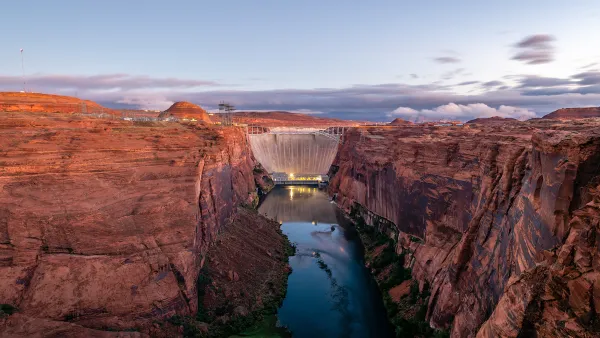
The Life and Death of American Dams
Many of the nation’s largest dam projects are reaching the end of their useful lives, helped along by nature.
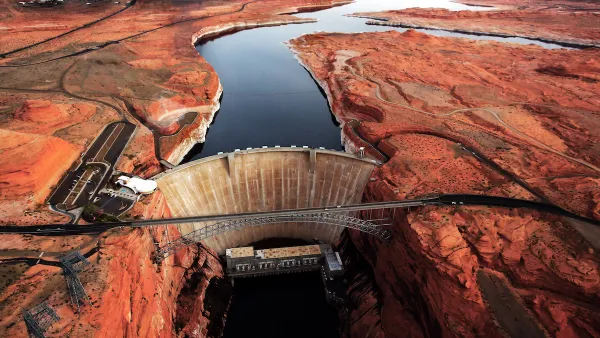
Calls Grow for ‘One-Dam Solution’ on Colorado River
California growers and others in the river’s Lower Basin want the federal government to consider draining Lake Powell to conserve more water downstream.
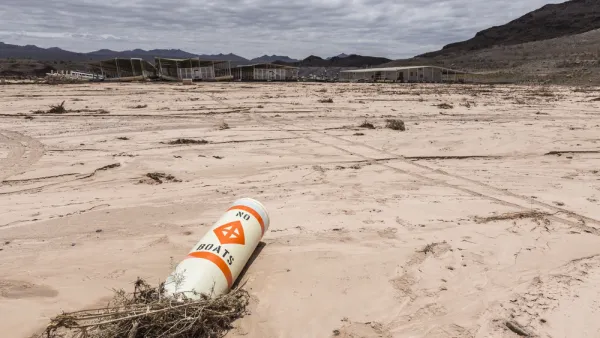
Federal Government Declares Water Shortage as Lake Mead Reaches Critical Low
The first-of-its-kind declaration triggers major water cutbacks for Arizona farmers and reduced allocations for Nevada and Mexico.

Desperate measures: Advocates weigh draining Lake Powell to fill Colorado River
Draining the reservoir could reduce evaporation losses by a couple hundred thousand acre-feet.

Eastern Nebraska is running out of electricity
Data centers and electrification are straining eastern Nebraska’s grid, throttling economic development.

Move over, LA: St. Louis gears up for Olympics, invests millions in downtown redevelopment
The Missouri city will host the 2028 Olympic soccer group stage and knockout matches.

Mass. votes against statewide minimum lot size for single-family homes
Over 2 million residents voted on Question 7; it was decided by just over 30,000 votes.

Maryland’s $15 billion bridge project gains key approval
The Maryland Transit Authority said the project will create over 60,000 jobs and add $23 billion to the local economy.

‘No clear next steps’ for Chicago's permanent festival grounds
Eleventh Ward Ald. Nicole Lee has suggested Soldier Field as a possible location for the permanent event space.

FREE Course: Walkable City 1: Why Walkability?
After describing his path towards focusing on walkability as the essence of good planning, Jeff Speck marches through his five principal reasons for making more walkable places.
Reinventing Malls: Planning Alchemy—Turning Gray Fields Into Gold
The course focuses on the opportunities and imperatives that shape reinvention of mall sites.

City of Rosemead
Rutgers University, Edward J. Bloustein School of Planning and Public Policy
One Hundred Miles
University of Michigan School for Environment and Sustainability (SEAS)
Hunter College, City University of New York (CUNY)
The Architects Foundation
City of Cambridge
The Pocatello Development Authority
The Urban Renewal Agency of the City of Pocatello