Activists organized to save their downtown San Diego neighborhoods from the NFL Chargers' stadium proposal. Their defense strategy? A fine-grained community plan with no stadium. In the process, they came upon the idea of a promenade and a "Nudillo."


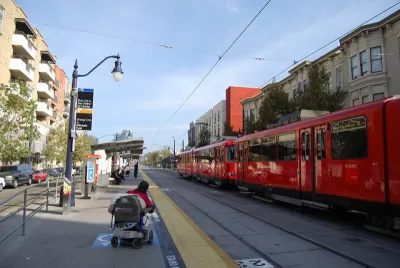
A group of community activists calling themselves the "Village People" have initiated a grassroots planning effort in the East Village of San Diego's downtown. The East Village area was repeatedly characterized as a wasteland by the NFL Chargers and their supporters, when their owner, Dean Spanos, and his consultants were trying to convince the city to build them a new stadium there. These activists showed the voters that the area had value and potential without a stadium. They held well-attended community workshops and out of that effort came some interesting ideas. They created a vision of what the area could become if spared the stadium bulldozers. They put the vision in a draft document called the East Village South Focus Plan.
Among the ideas coming from this effort was a pedestrian promenade through the heart of the would-be stadium site. The promenade would create a connection between downtown and Barrio Logan at a junction where the respective communities' different street grids abut. At this juncture, the promenade would take a slight turn, which they named the "Nudillo" (or knuckle). It would be marked with a landmark such as an obelisk and perhaps a round-a-bout. The Chargers derided the community vision as "airy-fairy," touting their stadium plan as vastly superior for the downtown. Nevertheless, the voters rejected the Chargers stadium, Dean Spanos moved his team to Los Angeles, and the Village People are now holding additional workshops to refine the promenade and Nudillo concepts. Michael-Leonard Creditor, a local design activist, attended the first workshop. He shares his photos and impressions in the source article.
Read the full story: A New Grand Pedestrian Promenade Through Downtown San Diego?
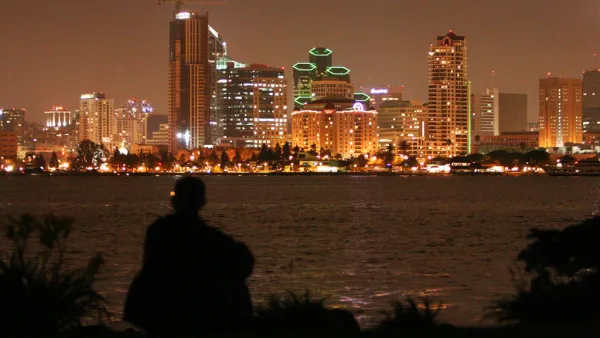
A Peek at the Future Downtown San Diego Without a New Charger Stadium
With two November ballot initiatives proposing to rezone a large part of downtown San Diego for a combined NFL stadium and convention facility, the community and a team of architects worked furiously to complete a more urban vision for the site.
Competing Visions for East Village—San Diego's SOMA
Downtown San Diego's East Village neighborhood shares traits with San Francisco's SOMA, circa 1990s. However, there are competing visions for the area: academic and high tech vs. stadium and convention center expansion.

Learning loss and urban schools, part 2
Did test scores in progressive cities drop more post-COVID than test scores in moderate ones?

Planetizen Federal Action Tracker
A weekly monitor of how Trump’s orders and actions are impacting planners and planning in America.

California plans to bury El Niño’s downpour
If the state plays its cards right, it may be able to store a billion acre-feet of El Niño’s water in aquifers.

Desperate measures: Advocates weigh draining Lake Powell to fill Colorado River
Draining the reservoir could reduce evaporation losses by a couple hundred thousand acre-feet.

US buildings threatened, destroyed by fires set to triple by 2060
Researchers found a high fire risk for socioeconomically vulnerable neighborhoods in the American West.

LA residents may be allowed to paint their own crosswalks
Councilwoman Katy Yaroslavsky put out a motion instructing the Los Angeles Department of Public Transportation to study the feasibility of allowing volunteers to paint crosswalks.

Dallas moves to overhaul its zoning code
The city's zoning reform will allow more multi-family and mixed-use developments.

FREE Course: Walkable City 1: Why Walkability?
After describing his path towards focusing on walkability as the essence of good planning, Jeff Speck marches through his five principal reasons for making more walkable places.
Reinventing Malls: Planning Alchemy—Turning Gray Fields Into Gold
The course focuses on the opportunities and imperatives that shape reinvention of mall sites.

City of Rosemead
Rutgers University, Edward J. Bloustein School of Planning and Public Policy
One Hundred Miles
Hunter College, City University of New York (CUNY)
The Architects Foundation
University of Cincinnati Online
City of Cambridge
Montrose County
The Pocatello Development Authority