While cities in the "Rust Belt" have shown some signs of recovery, one worrying indicator is the large and growing distances between people and jobs. Clustering economic opportunity around job hubs could help.


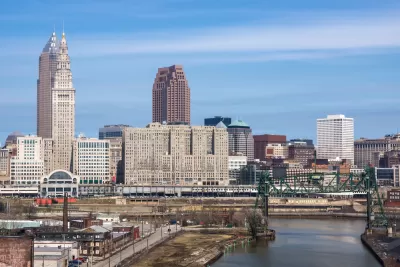
Pointing to the spacial disconnect between residents and jobs in places like Cleveland, Peter Truog writes, "Are these cities really something to believe in? They may be—if we can collectively find a way to connect economic opportunity with historically isolated and disconnected populations. If we don't, our comeback banners will lie in tatters."
Inefficiencies and personal difficulties hamper economic recovery in a region with so-called "job sprawl." Truog suggests designated job hubs as a way to coordinate that recovery. "A key part of the job hub idea is that it's a clustering of business activity—as opposed to a single large employer. It boasts assets like existing infrastructure and utilities that are attractive to multiple kinds of businesses."
"Job hubs can help city and regional leaders decide where to make investments, so that a region can offer more of the kinds of properties businesses are seeking. Economic development organizations can work with transportation planners and transit agencies to prioritize highway projects and provide better transit service to job hubs."
Read the full story: One Key to a Rust Belt Comeback: Job Hubs

Economic Recovery in Legacy Cities
Americans living in legacy cities face a unique set of challenges and opportunities in recovering from the COVID-19 pandemic. Several local, state, and federal support strategies could aid these cities in recouping losses.

What Are America's Fastest-Growing Cities?
Views about urban growth and decline often rely on statistics for metropolitan regions rather than cities proper. Here, Richard Florida looks at the fastest- and slowest-growing cities in America, separate from their metro areas.

Report: Cleveland and Akron Showing Strength in the Heartland
While much of the news focuses on declining population and vacant homes, Cleveland and Akron have quietly outperformed many other cities on quality of life.

Planetizen Federal Action Tracker
A weekly monitor of how Trump’s orders and actions are impacting planners and planning in America.

Amtrak, CN end decades-long dispute with eight-year agreement
The new operating agreement establishes an updated framework for the companies to work together, including processes to resolve disputes.

Northwest rail fans eager for Sept. 30 debut of Amtrak’s Airo fleet
Get ready for that new train smell and more seats. But they won’t go faster or run more frequently on the Cascades route in Washington and Oregon.

Brightline Florida files for bankruptcy
The transit company is over $5 billion in debt.

St. Louis Metro to test if single-car trains can reduce operating costs, maintain rider satisfaction
The pilot program will run from October to spring 2027, and begin with one single-car train operating on Metrolink’s Red and Blue lines.

Pennsylvania is building data centers in abandoned mines
Housing data centers in mines provides an alternative to destroying local forests and may spare residents from data centers’ noise and air pollution.

FREE Course: Walkable City 1: Why Walkability?
After describing his path towards focusing on walkability as the essence of good planning, Jeff Speck marches through his five principal reasons for making more walkable places.
Reinventing Malls: Planning Alchemy—Turning Gray Fields Into Gold
The course focuses on the opportunities and imperatives that shape reinvention of mall sites.

City of Thousand Oaks
City of Wisconsin Rapids
Harvard University Graduate School of Design
The Architects Foundation
University of Cincinnati Online
The Pocatello Development Authority
The Urban Renewal Agency of the City of Pocatello