Sidewalk-adjacent eating spaces generally separate diners from pedestrians. By using markers instead of fences, some Seattle eateries are opening their dining areas to the street.


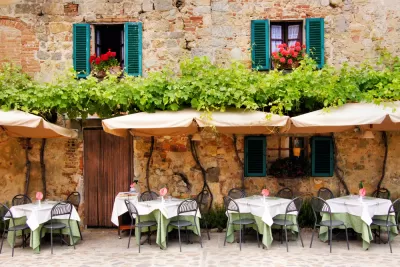
To fence or not to fence? Stephen Fesler discusses a Seattle Department of Transportation initiative promoting fence-free cafes. "Sidewalk cafés are a traditional element of right-of-way use that goes back centuries. They provide for street activation and can be a reasonable use of excess space in the public realm."
In part, regulations around how establishments serve liquor determine whether they can go fence-free. "The fence-free sidewalk cafés came about as an option in response to changes by the Washington State Liquor and Cannabis Board that allows restaurants to serve alcohol on sidewalks as long as pavement makers clearly identify the bounds of the sidewalk café."
Of course, the prospect of an unfenced outdoor dining experience may not be to everyone's liking. Fesler writes, "Some sidewalk café patrons may not be terribly keen on passerby walking so closely by–but such is the life of a busy, dense urban environment."
Read the full story: Seattle’s Sidewalk Café Are Going Fence-Free

Without Sidewalks, Making Seattle Streets More Pedestrian Friendly
Over a quarter of city blocks lack sidewalk infrastructure. An advocacy project to reduce traffic speeds and increase pedestrian safety on these streets has evolved into a city-funded program.
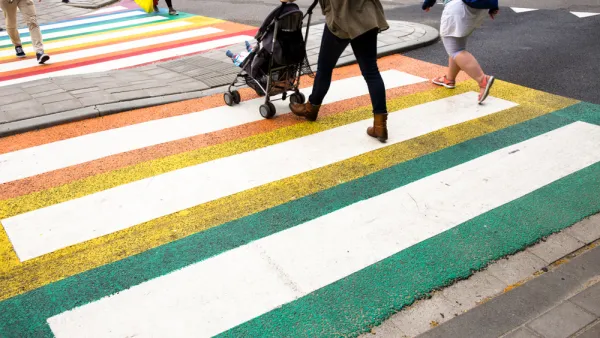
A 'Curious' New Report on Pedestrian Behavior in Public Spaces
The Seattle Department of Transportation recently released its first-ever public life study.
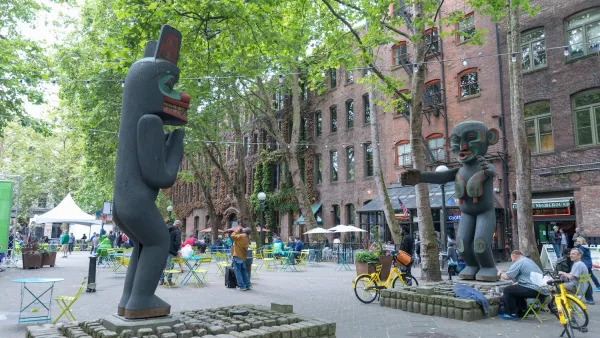
Seattle's Pioneer Square to become pedestrian zone during World Cup
The city will restrict car traffic and street parking in areas around Lumen Field on match days.

Planetizen Federal Action Tracker
A weekly monitor of how Trump’s orders and actions are impacting planners and planning in America.

Amtrak, CN end decades-long dispute with eight-year agreement
The new operating agreement establishes an updated framework for the companies to work together, including processes to resolve disputes.

Judges permit Denver to divert 77,000 acre feet from the Colorado River for reservoir expansion
Overuse and climate change have caused the Colorado River’s water levels to plummet.

NYC DOT wants faster, more permanent street upgrades
The city is examining ways to build more concrete infrastructure without getting entangled in 'decades-long' projects.

'Something we’ve never seen before:' rising utility rates could strain city finances nationwide
Data centers, climate change and other factors have caused utility rates in the United States to increase by 38% since 2020.

Trump to overrule local leaders, lease millions of acres of America’s Pacific Island territories’ seafloors to mining companies
International law says that the Indigenous people of America’s territories have a right to prior and informed consent regarding projects that impact their countries.

FREE Course: Walkable City 1: Why Walkability?
After describing his path towards focusing on walkability as the essence of good planning, Jeff Speck marches through his five principal reasons for making more walkable places.
Reinventing Malls: Planning Alchemy—Turning Gray Fields Into Gold
The course focuses on the opportunities and imperatives that shape reinvention of mall sites.

Harvard University Graduate School of Design
KFH Group Inc.
Greater Baltimore Committee
The Architects Foundation
University of Cincinnati Online
The Pocatello Development Authority
The Urban Renewal Agency of the City of Pocatello