New subdivision planning and construction is expected to expand the footprint of the Louisville metropolitan area. The question is whether those new developments will protect or harm the beloved Floyds Fork.


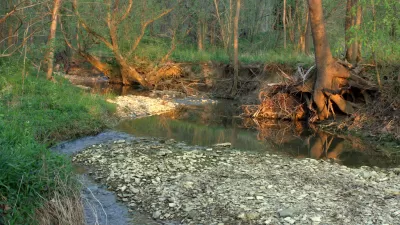
"One of the surest ways to kill a stream is to build a city around it," writes James Bruggers. Louisville is in danger of proving that maxim true another time.
"Most Louisville creeks and streams have long been in terrible condition….But not Floyds Fork," writes Bruggers.
Now, however, the stream is at what Bruggers describes as a critical juncture: "Its Clean Water Act protection is stuck in a bureaucratic quagmire — the stream's future tied to the fate of the last, large area of Jefferson County not already fully developed."
Developers have turned their post-recession attention to the relatively undeveloped southeast corner of Jefferson County. There the recently opened Parklands of Floyds Fork has provided proof of concept for the popularity of open space with water running through it. "Yet despite the city and federal governments spending nearly $1 million of taxpayer money on various Floyds Fork studies going back a decade, there's still no agreement on how to improve the creek's water quality."
Read the full story: How to kill a Louisville stream? Build a city around it
Parks Endowment Ready to Develop Park-Adjacent Land in Louisville
The Parklands of Floyds Fork has attracted development attention for years, but now the endowment that fought for the park's creation is proposing a development on land adjacent to the park to help fund the maintenance of the Parklands.
New Development, Open Space Set to Clash in Louisville Again
The Covington by the Park development proposal is back. The developer has revised previously stalled plans for a conservation subdivision on Louisville's eastern edge.

94% of wetlands could lose federal protections under proposed EPA rule
The ruling would only allot federal protections to waterways that flow nearly everyday, which few wetlands do.

Planetizen Federal Action Tracker
A weekly monitor of how Trump’s orders and actions are impacting planners and planning in America.

Eastern Nebraska is running out of electricity
Data centers and electrification are straining eastern Nebraska’s grid, throttling economic development.

Washington state to charge fee to drivers with fuel-efficient cars
Revenue from the fee will go towards supporting the state’s highways.

Instead of building new housing, LA developers are turning mansions into mega-mansions
In the richest areas, the number of houses valued at $30 million with demolition permits has skyrocketed since 2018.

Illinois considers spending $1 billion in taxpayer money on data center
A quantum computing campus and data center are currently under construction in Chicago.

As development costs rise, Boston moves to lessen affordable housing requirements
The Boston Zoning Commission and the City Council still need to approve Boston Mayor Michelle Wu’s proposed changes

FREE Course: Walkable City 1: Why Walkability?
After describing his path towards focusing on walkability as the essence of good planning, Jeff Speck marches through his five principal reasons for making more walkable places.
Reinventing Malls: Planning Alchemy—Turning Gray Fields Into Gold
The course focuses on the opportunities and imperatives that shape reinvention of mall sites.

City of Charlotte
City of Rosemead
Rutgers University, Edward J. Bloustein School of Planning and Public Policy
University of Michigan School for Environment and Sustainability (SEAS)
Hunter College, City University of New York (CUNY)
The Architects Foundation
University District Partnership
City of Cambridge
The Pocatello Development Authority