For the second time in its history, Louisville completed an ambitious and massive park planning and design process on its suburban fringe. The fringe today is just a bit farther out than it was in Olmsted's day.


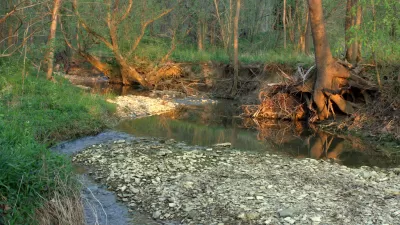
Jen Kinney writes that this month in Louisville, "nonprofit 21st Century Parks is celebrating the completion of a new greenway on Louisville’s now expanded limits, the city’s first major public-private partnership to construct new parks." All told, the Parklands of Floyds Fork cost $125 million, creating 2,000 acres and nearly 20 miles of continuous parkways.
As Kinney notes, the new park is an echo of the park planning of Louisville's past: over 100 years ago, "Frederick Law Olmsted designed a system of 18 parks linked by 14.5 miles of greenery-ed boulevards around the then-urban edges of Louisville…"
Now the suburban edge of the city is decidedly farther out from the urban core, on land requiring a very involved series of transactions to assemble. According to Kinney, "21st Century Parks engaged in 80 separate land transactions with a variety of owners to piece together the park over the course of eight years. None of the land was acquired by eminent domain or condemnation."
The article includes more details about the amenities and facilities included in the completed park. City officials are expecting 2 million visitors to the park this year.
Read the full story: Louisville Looks to the Edges for New Parks, Once Again
Not a Walk in the Park: What It Really Takes to Build Green Spaces
Park creation can take decades of perseverance to overcome financial, regulatory, and social hurdles, but the end result for the local community is more than worth it.
Envisioning a New Park in East Los Angeles
Los Angeles County is working towards transforming underutilized land into a vibrant pocket park in the City Terrace neighborhood of East LA.

Using Cellphone and Fitness App Data for Park Planning
Data from smartphone apps and fitness trackers are helping planners to better understand park usage patterns and plan for new and improved parks.

Planetizen Federal Action Tracker
A weekly monitor of how Trump’s orders and actions are impacting planners and planning in America.

California plans to bury El Niño’s downpour
If the state plays its cards right, it may be able to store a billion acre-feet of El Niño’s water in aquifers.

Desperate measures: Advocates weigh draining Lake Powell to fill Colorado River
Draining the reservoir could reduce evaporation losses by a couple hundred thousand acre-feet.

Seattle passes record-breaking transit services expansion
Proposition 1 will double the city’s transit tax to add 95,000 more bus trips and preserve 180,000 bus trips annually.

Post election, Texas is no longer Musk’s 'AI oasis'
Elon Musk dolled out $446 million on the 2026 midterms, the most ever spent by a non-canidate.

Chicago voters approve permanent festival grounds, penalty for vacant property owners
Currently, major summer and fall festivals take over public parks for weeks at a time, drawing criticism from nearby residents

FREE Course: Walkable City 1: Why Walkability?
After describing his path towards focusing on walkability as the essence of good planning, Jeff Speck marches through his five principal reasons for making more walkable places.
Reinventing Malls: Planning Alchemy—Turning Gray Fields Into Gold
The course focuses on the opportunities and imperatives that shape reinvention of mall sites.

City of Rosemead
Rutgers University, Edward J. Bloustein School of Planning and Public Policy
One Hundred Miles
Hunter College, City University of New York (CUNY)
The Architects Foundation
University of Cincinnati Online
City of Cambridge
Montrose County
The Pocatello Development Authority