Austin has mostly been planning, designing, and engineering its streets the same way for 20 years. A new Street Design Guide would pave the way for a new era.


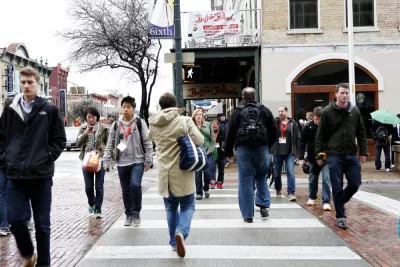
Syeda Hasan reports on the new draft of the Austin Street Design Guide [pdf], released earlier this week.
"The guide takes into account some key considerations to try and make Austin streets more uniform and consistent, including the community surrounding a street, the number of lanes and different modes of transportation options, like bikes and public transit," writes Hasan.
"The new guide divides each street into three sections – pedestrian zones, bicycle zones and motor vehicle and transit zones; it recommends dimensions for each of those features. It also categorizes streets by their context, like urban, suburban or industrial," adds Hasan.
The article includes soundbites provided by Annick Beaudet, a manager with the Austin Transportation Department, and Liane Miller, a project manager with the Austin Transportation Department. Both provide insight into how the guide will update the city's existing transportation plan.
Though the city's transportation plan hasn't been updated in 20 years, the city did earn acclaim for its 2014 complete streets policy.
Read the full story: Austin Unveils New Guide For The Future Of Street Design
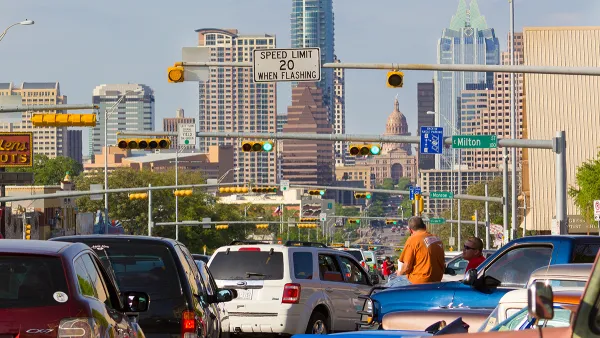
Austin Strategic Mobility Plan Final Draft Released
The first priority of the draft Austin Strategic Mobility Plan is to reduce single-occupant vehicle trips.

Catch Up With Austin's CodeNEXT
CodeNEXT is one of the most ambitious, and controversial, zoning reform projects ongoing in the country, with lessons to offer planners all over the country in code writing, public outreach, and planning outcomes.

US Street Design Manual Inches Toward Safer Roads
The guiding document for U.S. road design is starting to recognize the needs of people walking and biking, but safe streets advocates say more significant changes are needed to reduce the high number of pedestrian deaths and improve connectivity for all road users.

Planetizen Federal Action Tracker
A weekly monitor of how Trump’s orders and actions are impacting planners and planning in America.

Eastern Nebraska is running out of electricity
Data centers and electrification are straining eastern Nebraska’s grid, throttling economic development.

Move over, LA: St. Louis gears up for Olympics, invests millions in downtown redevelopment
The Missouri city will host the 2028 Olympic soccer group stage and knockout matches.

Dallas releases zoning code overhaul to officials
The drafted overhaul is over 400 pages long.

NYC renovations for dangerous, ‘mercilessly crammed’ street delayed until 2027
Construction was supposed to begin this fall.

San Diego’s Midway Rising project gets greenlight from city council
The project looks to become the largest affordable housing development in California's history.

FREE Course: Walkable City 1: Why Walkability?
After describing his path towards focusing on walkability as the essence of good planning, Jeff Speck marches through his five principal reasons for making more walkable places.
Reinventing Malls: Planning Alchemy—Turning Gray Fields Into Gold
The course focuses on the opportunities and imperatives that shape reinvention of mall sites.

City of Rosemead
Rutgers University, Edward J. Bloustein School of Planning and Public Policy
One Hundred Miles
University of Michigan School for Environment and Sustainability (SEAS)
Hunter College, City University of New York (CUNY)
The Architects Foundation
City of Cambridge
The Pocatello Development Authority
The Urban Renewal Agency of the City of Pocatello