Ben Brown tells us to stop narrowly defining problems.



"When the dust settles after the current traumas, I think we’ll see this time in our lives and in our nation’s history as a period in which what we’ve learned about human psychology, democracy and policy-making at every scale has exposed weaknesses in ourselves and our institutions that will take a while to fix. And that could be a good thing."
"We’re wired to seek simple solutions, even when evidence suggests hairballs of complexity. And the more stressed we are, the faster we default to The Answer. Evolution encourages us to be hammers in search of nails."
"Needless to say, this has not always worked well for us. (See racism, genocide, xenophobia, etc. Also Urban Renewal and the 2016 presidential election.)"
Brown suggests that particularly with the challenge of our aging population, our solution set should be wide and multi-faceted. It may take a village to raise a child, but it also takes one to nurture elders.
Read the full story: The Other Side of Anxiety? Realism. And maybe hope.
Imminent Doom as Grand Strategy
What do three-pack-a-day smoking habits, triple-decker cheese burgers and sprawl have in common? They all offer immediate gratification and deferred consequences. But now the bill's coming due. Ben Brown lays out some ways to face the music.
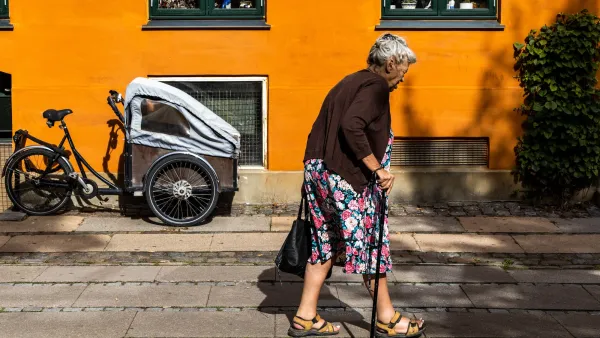
Great Cities Don’t Just Acknowledge That We Age In Them — They Build For It. We Can Too.
We age in sidewalks, public spaces, transit stops, and community centers — not in hospitals. As populations age, the built environment will determine whether our cities thrive or struggle in the decades ahead.

New Mexico Aging Department Commits to Helping Seniors Age ‘In Place’ and ‘Autonomously’ in New Draft Plan
As New Mexico’s population of seniors continues to grow, the state’s aging department is proposing expanded initiatives to help seniors maintain their autonomy while also supporting family caregivers.

Planetizen Federal Action Tracker
A weekly monitor of how Trump’s orders and actions are impacting planners and planning in America.

California plans to bury El Niño’s downpour
If the state plays its cards right, it may be able to store a billion acre-feet of El Niño’s water in aquifers.

Desperate measures: Advocates weigh draining Lake Powell to fill Colorado River
Draining the reservoir could reduce evaporation losses by a couple hundred thousand acre-feet.

Mamdani’s pied-à-terre tax survives legal challenge
A panel of judges found that the plaintiffs failed to demonstrate injury as a result of New York City's implementation of the tax.

Eastern Nebraska is running out of electricity
Data centers and electrification are straining eastern Nebraska’s grid, throttling economic development.

Seattle passes record-breaking transit services expansion
Proposition 1 will double the city’s transit tax to add 95,000 more bus trips and preserve 180,000 bus trips annually.

FREE Course: Walkable City 1: Why Walkability?
After describing his path towards focusing on walkability as the essence of good planning, Jeff Speck marches through his five principal reasons for making more walkable places.
Reinventing Malls: Planning Alchemy—Turning Gray Fields Into Gold
The course focuses on the opportunities and imperatives that shape reinvention of mall sites.

City of Rosemead
Rutgers University, Edward J. Bloustein School of Planning and Public Policy
One Hundred Miles
University of Michigan School for Environment and Sustainability (SEAS)
Hunter College, City University of New York (CUNY)
The Architects Foundation
City of Cambridge
Montrose County
The Pocatello Development Authority