Portland, Oregon lives up to its reputation as a testing ground for urbanism innovation by approving what will become the nation's tallest wood framed building.


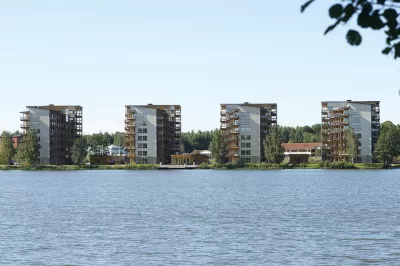
"An 11-story timber high-rise planned in Portland's Pearl District has been approved for construction," reports Elliot Njus, "a milestone for wood technology that could allow for even taller timber buildings."
"At 148 feet, the Framework building will be the nation's first high-rise building made of wood," adds Njus.
As reported in another article by Njus and Molly Harbarger, Portland is pressing for more wood construction to support the region's timber industry.
Other cities around the world, like Toronto, are allowing larger wood framed buildings because they tend to be cheaper than steel framed buildings. High profile examples of timber skyscrapers have been proposed in Paris and Minneapolis. Skepticism toward the building practice can still be found in the Atlanta suburb of Sandy Springs, however, which recently took steps to limit the construction of wood framed buildings.
FULL STORY: Timber high-rise planned in Pearl District gets construction permit

Wood Frame Construction Has Yet to Catch Up to Regulations in Toronto
When it comes to housing construction, the best intentions of regulators aren't always enough to sway the market.
Building Material of the Future: Wood
A proposed development in in the North Loop section of Minneapolis would be the first of its kind. According to the architect behind the design, the "T3" project, as its known, could be a harbinger of buildings to come.

Atlanta Suburb Limits Wood-Framed Buildings
In an era where cities all over the world are allowing larger and taller wood-framed buildings, the city of Sandy Springs just approved sweeping limitations on the construction practice.

Planetizen Federal Action Tracker
A weekly monitor of how Trump’s orders and actions are impacting planners and planning in America.

The state-sanctioned urbicide of Austin
People don’t kill cities. Freeways do.

US to reduce Colorado River water deliveries to Mexico
A new Colorado Treaty amendment reduces Mexico’s Colorado River water allocation by 250,000 acre feet.

Mamdani overhauls NYC's Vision Zero plan with 100 new policy goals
The overhaul aims to reduce traffic deaths and make streets safer for pedestrians, cyclists and drivers through lower speed limits, new safety infrastructure and more.

Amtrak not solely to blame for New Jersey commuter rail's unreliability, report finds
A new study from the Garden State Initiative found that NJ Transit’s budget grew 20% across a 4 year period, but reliability declined significantly over the same period.

EPA erases limits on planet-warming pollution from power plants
Under Monday’s plan, power plants would still have some limits on how much mercury, arsenic and other contaminants they can emit.

FREE Course: Walkable City 1: Why Walkability?
After describing his path towards focusing on walkability as the essence of good planning, Jeff Speck marches through his five principal reasons for making more walkable places.
Reinventing Malls: Planning Alchemy—Turning Gray Fields Into Gold
The course focuses on the opportunities and imperatives that shape reinvention of mall sites.

Eagle County Government
Harvard University Graduate School of Design
Nashville Planning Department
The Architects Foundation
University of Cincinnati Online
The Pocatello Development Authority
The Urban Renewal Agency of the City of Pocatello
Journal of the American Planning Association