The timing of the announcement of deeply ambitious energy goals by the city of Portland and the county of Multnomah was not coincidental.


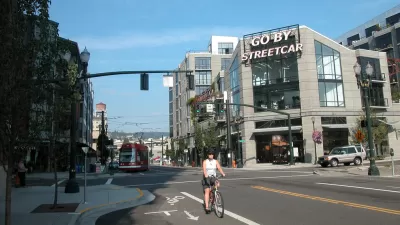
"On the day the Trump administration withdrew from the Paris climate agreement, the City of Portland and Multnomah County committed to a goal of meeting 100 percent of community energy needs with renewable power by 2050," reports Ted Sickinger. Community energy needs include transportation and industry for the entire county.
The city's version of the resolution represents a "veritable Christmas tree of commitments," writes Sickinger. Included in the resolution are commitments for "more energy efficiency, demand control, community-based renewable energy, job training, transit expansion, electric buses, minority- and women-owned business participation, and climate justice measures such as rate protections, low transit fares and job training for low-income residents that could be disproportionately affected by climate change and the transition to clean power."
The article includes quotes from a statement by Portland Ted Wheeler saying the action by the city and county "will serve as a beacon of hope" on a day that "the United States is effectively turning its back on the rest of the world."
Read the full story: Portland, Multnomah County set 100% renewable energy goal

Portland's clean energy fund has generated $1 billion for climate action
Since 2019, the city has levied a 1% sales tax on large corporations to support climate resilience and clean energy projects.
Report: U.S. Greenhouse Gas Reductions Not Hitting Paris Agreement Goal
The United States is making modest gains in the power and transportation sectors, but emissions in the industrial sector are holding steady, absent new reduction initiatives.
Carbon Emissions Back on the Rise—Along With Cleaner Energy
Climate-friendly government policies and recent investments by energy companies are accelerating the growth of renewables.

Planetizen Federal Action Tracker
A weekly monitor of how Trump’s orders and actions are impacting planners and planning in America.

California plans to bury El Niño’s downpour
If the state plays its cards right, it may be able to store a billion acre-feet of El Niño’s water in aquifers.

Desperate measures: Advocates weigh draining Lake Powell to fill Colorado River
Draining the reservoir could reduce evaporation losses by a couple hundred thousand acre-feet.

Los Angeles just elected an urban planner as its mayor
Transportation analysts are optimistic that Raman will be more aggressive in addressing transit issues than Bass.

Mamdani’s pied-à-terre tax survives legal challenge
A panel of judges found that the plaintiffs failed to demonstrate injury as a result of New York City's implementation of the tax.

Eastern Nebraska is running out of electricity
Data centers and electrification are straining eastern Nebraska’s grid, throttling economic development.

FREE Course: Walkable City 1: Why Walkability?
After describing his path towards focusing on walkability as the essence of good planning, Jeff Speck marches through his five principal reasons for making more walkable places.
Reinventing Malls: Planning Alchemy—Turning Gray Fields Into Gold
The course focuses on the opportunities and imperatives that shape reinvention of mall sites.

City of Rosemead
Rutgers University, Edward J. Bloustein School of Planning and Public Policy
One Hundred Miles
University of Michigan School for Environment and Sustainability (SEAS)
Hunter College, City University of New York (CUNY)
The Architects Foundation
City of Cambridge
Montrose County
The Pocatello Development Authority