The Napa River's Oxbow bypass doubles as public park space and an outlet when the river floods. The project brought together local environmentalists and the business community.



John King offers up a defense of the Oxbow bypass, a costly flood control project that doubles as a park. He writes, "it performed exactly as predicted back in 1998, when Napa County voters approved a half-cent sales tax to fund their portion of a multifaceted flood control project through the city of 80,000."
Backers of the "living river" were diverse, including the Sierra Club and the Napa Chamber of Commerce. "Environmentalists knew they wouldn't gain the necessary two-thirds support from voters without the backing of local business. Business groups understood that a safe attractive river might make the long-moribund downtown more enticing."
King acknowledges (but pushes against) critiques leveled at the project's expense. "Oxbow bypass didn't open until 2015, seven years after the project was supposed to be done. The budget soared past $500 million from an initial estimate of $220 million, due in part to the cost of purchasing 53 mobile homes and 44 structures along the river's path."
Read the full story: ‘Living river’ rejuvenates Napa, brings needed flood control

Turning Disaster Into Opportunity
Brian Phelps reports on the power of urban landscaping to revitalize a flood-devastated city - Valencia, Spain.

Historic Queens park is getting a $120M upgrade
The borough's largest park will undergo significant upgrades for accessibility, flood mitigation and historic preservation.
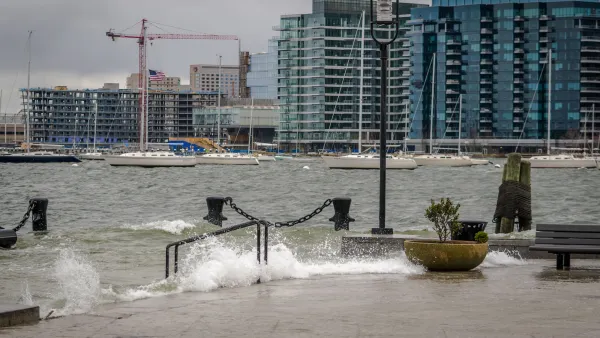
Boston releases draft $10B flood prevention plan
The joint effort with the U.S. Army Corps of Engineers outlines multiple strategies for protecting the city's most vulnerable neighborhoods from sea level rise.

Planetizen Federal Action Tracker
A weekly monitor of how Trump’s orders and actions are impacting planners and planning in America.

California plans to bury El Niño’s downpour
If the state plays its cards right, it may be able to store a billion acre-feet of El Niño’s water in aquifers.

Chicago breaks ground on $3 billion megadevelopment
The new neighborhood, titled Foundry Park, will one day host 3,700 residences.

California High-Speed Rail Authority CEO resigns after $600,000 scandal
Under Ian Choudri, the authority used taxpayer dollars to fund first class flights and trips to nightclubs.

Want to study the Missouri River? Soon, you may need unanimous approval from 10 states
Legislation would require 10 governors’ permission to study or build projects moving water outside the basin.

Desperate measures: Advocates weigh draining Lake Powell to fill Colorado River
Draining the reservoir could reduce evaporation losses by a couple hundred thousand acre-feet.

FREE Course: Walkable City 1: Why Walkability?
After describing his path towards focusing on walkability as the essence of good planning, Jeff Speck marches through his five principal reasons for making more walkable places.
Reinventing Malls: Planning Alchemy—Turning Gray Fields Into Gold
The course focuses on the opportunities and imperatives that shape reinvention of mall sites.

City of Rosemead
Rutgers University, Edward J. Bloustein School of Planning and Public Policy
One Hundred Miles
Hunter College, City University of New York (CUNY)
The Architects Foundation
University of Cincinnati Online
City of Cambridge
Montrose County
The Pocatello Development Authority