Brian Phelps reports on the power of urban landscaping to revitalize a flood-devastated city - Valencia, Spain.


An exquisite example of transforming a disaster into an opportunity, Valencia's lush landscaped sanctuary known as Jardín del Turia, or Green River, took the place of what once was the Turia River after a devastating flood rocked the city in 1957. Citing Rahm Emanuel, "You never want a serious crisis to go to waste."
The idea for the Green River was born after the city re-routed the river to the west, leaving traces of old riverbeds and open space behind. When the city proposed to develop highways there, locals demanded that they build a park instead, and Plan Sur was created. The parks were completed in 1969 and include over 450 acres of land spanning through the lengths of the old riverbed. Each section of green space is a brilliant testament to the city's culture, with distinct designs "ranging from Ricardo Bofill's formal gardens with modern touches, built in 1986; and Calatrava's biomorphic City of Arts and Sciences, completed in 1998; to the sinuous landforms of Header Park by Eduardo de Miguel Rabones, Blake Muñoz Criado, and Vicente Corell Farinós, completed in 2004."
This type of environmental intervention seems to have worked for Valencia in the past, but, Phelps wonders, is this manner of flood control workable today? "Despite the apparent success of Plan Sur in preventing flooding, the long-term impact of diverting the Turia River is unknown," he writes. However, giving credit where it is due, Phelps adds that "Born out of a crisis, Valencia has managed to integrate a recreational and transportation infrastructure network with its historic heart and surrounding neighborhoods."
Read the full story: Valencia's Green River

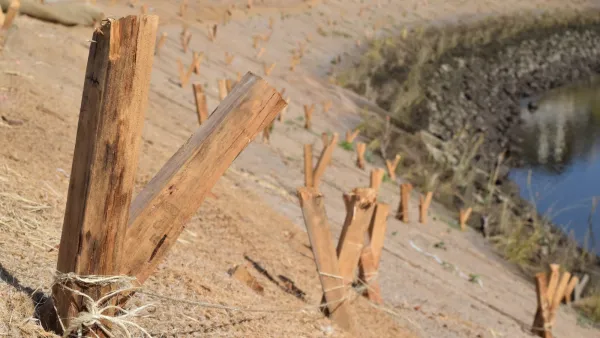
Partnerships Drove Napa Flood Control Project
The Napa River's Oxbow bypass doubles as public park space and an outlet when the river floods. The project brought together local environmentalists and the business community.
New Plaza Preserves Unexpected Historical Find
Plans to build a parking garage below an old plaza in Seville, Spain, revealed underground roman ruins. So the city built a new structure to hover over the site and to emphasize the area's historic amenities.
Bilbao Beyond the Guggenheim
Bilbao is known for the Frank Gehry-designed Guggenheim Museum. But there's a living city behind that iconic architecture, and local officials are trying to prove it with a new public park.

Planetizen Federal Action Tracker
A weekly monitor of how Trump’s orders and actions are impacting planners and planning in America.

Chicago breaks ground on $3 billion megadevelopment
The new neighborhood, titled Foundry Park, will one day host 3,700 residences.

This MA town is drowning in its own sewage — and residents like it that way
Susan Murcott, a waste water expert, said if Carlisle didn't address their leaking sewage, the problem could turn “deadly.”

Iowa taxpayers are paying thousands to clean manure out of their water
While the Clean Water Act makes states responsible for regulating factory farms that discharge pollutants, Iowa has turned a blind eye to the polluting farms.

Amtrak cuts ribbon on Seattle Airo maintenance facility
The $250 million, nearly 100,000-square-foot building can house an entire Cascades Airo trainset.

To power data centers, Google seeks autonomous control of thousands of homes’ electricity
The tech company has signed a deal to indirectly pay Mid-Atlantic residents to reduce their power demand when the grid is strained.

FREE Course: Walkable City 1: Why Walkability?
After describing his path towards focusing on walkability as the essence of good planning, Jeff Speck marches through his five principal reasons for making more walkable places.
Reinventing Malls: Planning Alchemy—Turning Gray Fields Into Gold
The course focuses on the opportunities and imperatives that shape reinvention of mall sites.


City of Rosemead
Rutgers University, Edward J. Bloustein School of Planning and Public Policy
One Hundred Miles
The Architects Foundation
University of Cincinnati Online
Montrose County
The Pocatello Development Authority
The Urban Renewal Agency of the City of Pocatello