Churchgoing in Washington, D.C. is on the decline, and neighborhood churches are finding it hard to pay the bills. One solution is to go mixed-use and share space with new development.


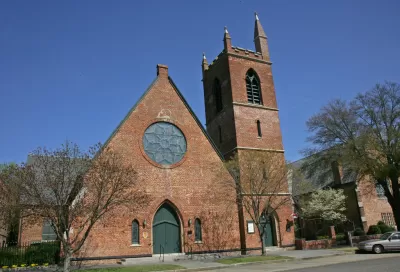
Church attendance isn't what it once was in central Washington, D.C. Dan Reed writes: "Once upon a time, congregations could anchor neighborhoods, but nowadays they can feel like a void. Because many are open just a few hours a week for Saturday and Sunday services and the occasional weeknight meeting, nearby sidewalks are empty because nobody has a reason to stop in."
That can make neighborhoods with a lot of churches seem more dangerous for pedestrians, dampening prospects for development. Reed cites a recent example of how an old church partnered with housing developers to build a combined structure. The building looks pretty unconventional, but the arrangement may let churches stay open.
"Congregations get a space that fits their current needs as well as the money to take care of it while carrying out their mission. Developers snag sought-after building sites plus a sympathetic partner able to win over abutters who may fight new construction in their back yard."
Read the full story: Why Developers Are Eyeballing DC’s Churches As Their Next Project
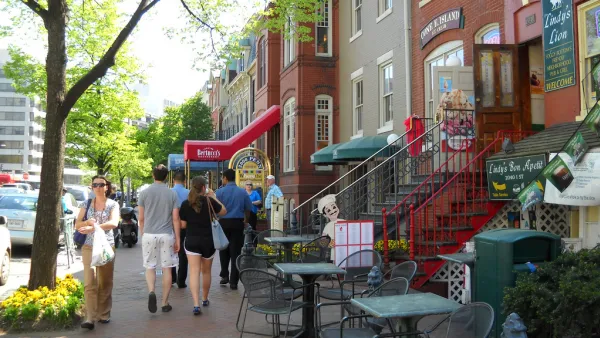
Mixed Use Could Lower Neighborhood Crime Rates
New research shows areas with a heavy concentration of commercial offices experience 40 percent higher crime rates than neighborhoods that mix residential and commercial uses.
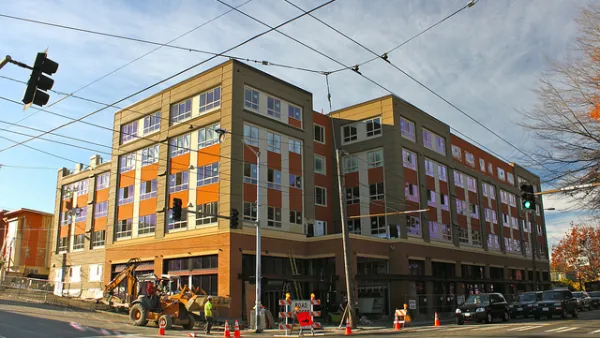
There's a Hole Where Ground-Floor Retail Should Be
Mixed-use developments still often operate better in theory than in reality.

Ground-Level Grocery Stores Proliferate in Boston
Being able to get groceries without a car can be a big draw in walkable, mixed use neighborhoods. Many Boston grocers and developers are taking that to heart.

Planetizen Federal Action Tracker
A weekly monitor of how Trump’s orders and actions are impacting planners and planning in America.

California plans to bury El Niño’s downpour
If the state plays its cards right, it may be able to store a billion acre-feet of El Niño’s water in aquifers.

Desperate measures: Advocates weigh draining Lake Powell to fill Colorado River
Draining the reservoir could reduce evaporation losses by a couple hundred thousand acre-feet.

Mamdani’s pied-à-terre tax survives legal challenge
A panel of judges found that the plaintiffs failed to demonstrate injury as a result of New York City's implementation of the tax.

Eastern Nebraska is running out of electricity
Data centers and electrification are straining eastern Nebraska’s grid, throttling economic development.

Seattle passes record-breaking transit services expansion
Proposition 1 will double the city’s transit tax to add 95,000 more bus trips and preserve 180,000 bus trips annually.

FREE Course: Walkable City 1: Why Walkability?
After describing his path towards focusing on walkability as the essence of good planning, Jeff Speck marches through his five principal reasons for making more walkable places.
Reinventing Malls: Planning Alchemy—Turning Gray Fields Into Gold
The course focuses on the opportunities and imperatives that shape reinvention of mall sites.

City of Rosemead
Rutgers University, Edward J. Bloustein School of Planning and Public Policy
One Hundred Miles
University of Michigan School for Environment and Sustainability (SEAS)
Hunter College, City University of New York (CUNY)
The Architects Foundation
City of Cambridge
Montrose County
The Pocatello Development Authority