Durham, North Carolina, joins the ranks of local government agencies who have shifted to an integrated development services model focused on customer service.



The Durham City-County Development Services Center (DSC) opened on April 3, 2017, with a mission of streamlining Durham’s development review process and enhancing customer service. A joint initiative of the Planning, Inspections, and Public Works Department, the DSC is both a new physical space and reorganization of program activities and staff. The DSC is intended to be a “one-stop-shop,” providing 1) application intake for Planning, Inspections, and Public Works, 2) in-person customer service, and 3) quick turn-around for minor planning and building projects.
Collectively, Durham’s development review process includes over seventy different permit and/or review types, spanning more than 20 city and county Departments. The rate and complexity of development in Durham has increased over time, giving rise to the concept of a more integrated service delivery model, as seen in other cities like San Diego, California; Redmond, Washington; and Portland, Oregon.
The broader trend toward integrated development services counterbalances the intense specialization occurring in the development industry. Within local governments, multiple work units are frequently involved in the development review process, from planning and public works, to transportation and sustainability. While these work units often perform well in their respective areas of expertise, the typical customer desires a single point of contact, whether they are asking a general question or applying for a specific project. An integrated customer service model like Durham’s ensures that the focus remains on customer service delivery, and allows a single work unit to continually evaluate the development review processes and improve its predictability, timeliness, and quality.
Creation of the DSC was led by Patrick O. Young, AICP, who was recently named director of the Durham City-County Planning Department. Mr. Young joined the department in 2008 as Assistant Director, and has helped advance the creation of affordable housing in Durham. He succeeds Steven L. Medlin, who retired after 30 years of service to the department.
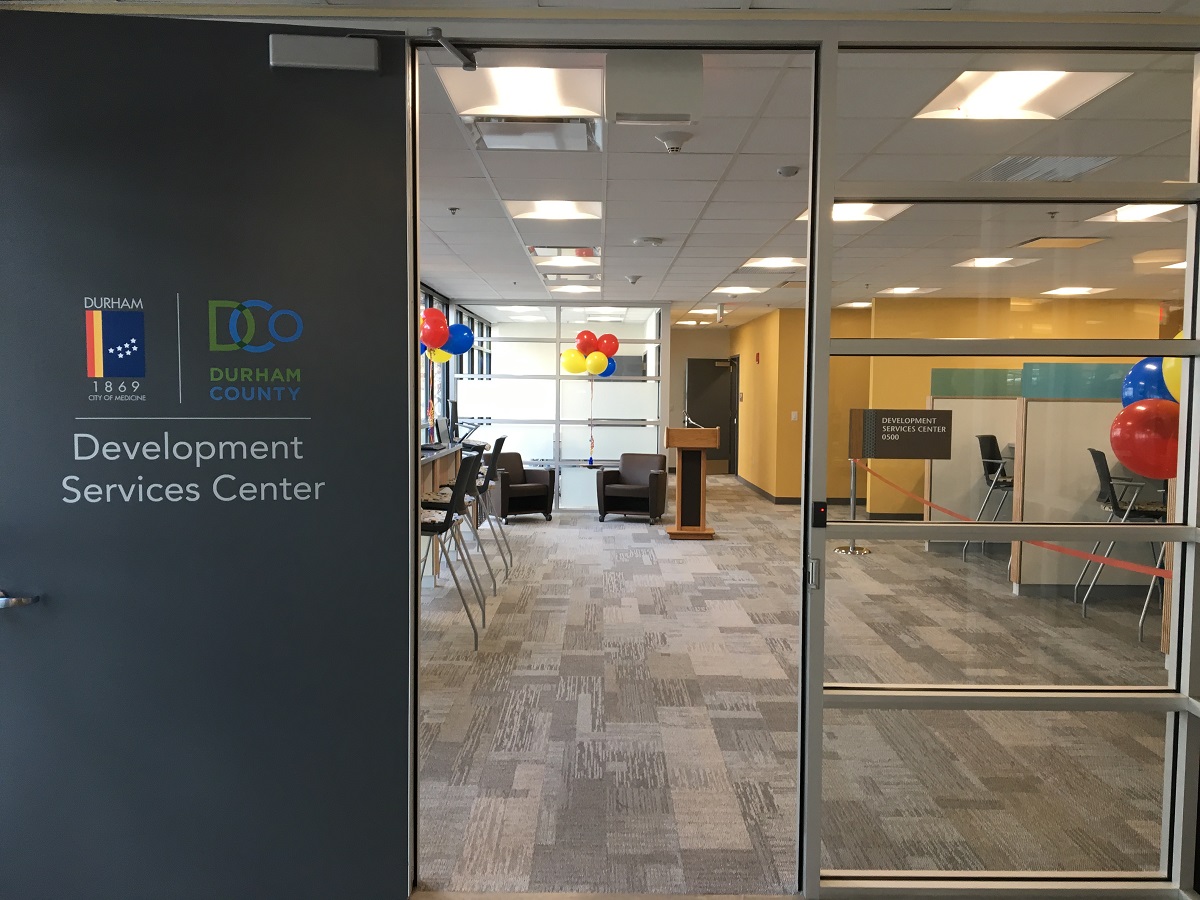
Read the full story: Durham Launches New Development Services Center
Durham, North Carolina Housing Bond Has Created 1,668 New Rental Homes
A 2019 housing bond has yielded better-than-expected results.
Durham Eliminates Parking Requirements
Another domino has fallen in the parking reform movement.
Quantifying the Potential of California’s ‘Yes in God’s Backyard’ Bill
A new report estimates that 171,000 acres of land would be available for housing development if California approves SB 4, Affordable Housing on Faith and Higher Education Lands Act of 2023.

Planetizen Federal Action Tracker
A weekly monitor of how Trump’s orders and actions are impacting planners and planning in America.

Washington state to charge fee to drivers with fuel-efficient cars
Revenue from the fee will go towards supporting the state’s highways.

Trump to blast ‘hydrocarbon highway’ through ‘world’s longest art gallery’
Environmental and historic preservation groups are suing to stop the project.

MBTA Green Line project moved to next phrase of CIG program
The modernization effort will cost $4.08 billion.

22-mile pedestrian and bike path to encircle Atlanta by 2030
The project will also support affordable housing.

Army detonates nearly 5 tons of lead in Iowa
The detonation comes after days of delays and public outcry.

FREE Course: Walkable City 1: Why Walkability?
After describing his path towards focusing on walkability as the essence of good planning, Jeff Speck marches through his five principal reasons for making more walkable places.
Reinventing Malls: Planning Alchemy—Turning Gray Fields Into Gold
The course focuses on the opportunities and imperatives that shape reinvention of mall sites.

City of Charlotte
City of Rosemead
Rutgers University, Edward J. Bloustein School of Planning and Public Policy
University of Michigan School for Environment and Sustainability (SEAS)
Hunter College, City University of New York (CUNY)
The Architects Foundation
University District Partnership