Palo Alto has become so expensive, plots of land with derelict houses sell for millions of dollars. Mathew Yglesias argues allowing small municipalities to make their own zoning laws is partly to blame.



NIMBYs in California's most expensive town are destructive to the state's economy, and Mathew Yglesias argues the state should take away their power to decide zoning rules by giving the state more power over zoning. "In the normal course of events, one might expect that land this expensive would become densely developed. But it turns out that the neighborhood in question isn’t full of large apartment towers," Yglesias writes in Vox. This is because the land is set aside for detached single family homes and nothing else can be built there.
In the interest of housing, more people and helping the state's economy, Yglesias argues that the state of California should intercede. "Stepping in to centralize more land use decisions in Sacramento would reveal that there is a strong broad statewide interest in more development," Yglesias argues. Streamlining the permitting process or allowing for more density in places like Palo Alto would bring down the value of some of the empty lots, but "housing affordability has become a problem that afflicts large swathes of the middle class," and Yglesias argues, the state needs to address that.
Read the full story: This $2.5 million Palo Alto teardown shows how coastal housing policy has gone wrong
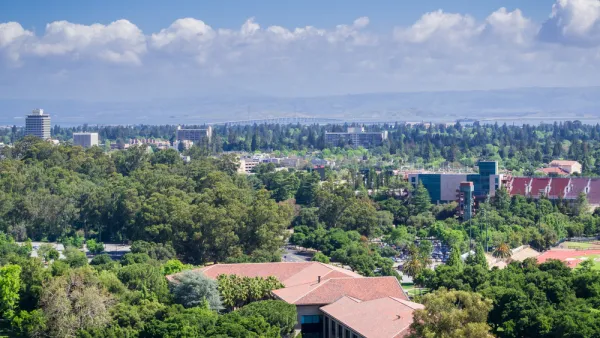
Opinion: Build Density in Palo Alto–and Lots of It
To keep up with demand and slow the astronomical rise in housing costs, Palo Alto and other Silicon Valley cities must overcome local opposition to density and high-rises.

Tiny House Movement Pushing the Boundaries of Traditional Zoning
Tiny Houses on trailers are available and buyers are ready to live small, but most zoning regulations don’t allow recreational vehicles as a permanent residence. Can zoning catch up to the tiny living trend?
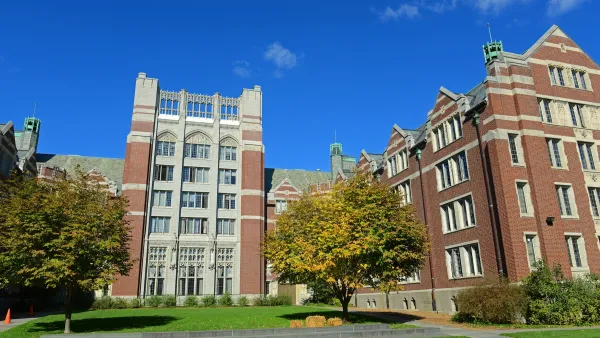
Wellesley sues state over proposed housing on state-owned parking lot
The college town opposes a 180-unit development that it says creates too much density for the area.

Planetizen Federal Action Tracker
A weekly monitor of how Trump’s orders and actions are impacting planners and planning in America.

Washington state to charge fee to drivers with fuel-efficient cars
Revenue from the fee will go towards supporting the state’s highways.

Study reveals best places in the U.S. for cycling, walking
New research from Streetlight Data examines bicycle and pedestrian miles per capita in the 100 largest U.S. cities by population.

Mamdani unveils his ‘most ambitious bus lane project’ so far
The city has added two new bus lanes, which it expects to speed up tens of thousands of bus riders’ commutes.

New Jersey and New York suggest $10.3 billion budget for transit
Some of the budget is dedicated to replacing Manhattan's Midtown Bus Terminal.

States split over EPA’s proposal to drop greenhouse gas rules for power plants
The proposed rule drew over 165K comments, including from officials, health and environmental groups, and private citizens.

FREE Course: Walkable City 1: Why Walkability?
After describing his path towards focusing on walkability as the essence of good planning, Jeff Speck marches through his five principal reasons for making more walkable places.
Reinventing Malls: Planning Alchemy—Turning Gray Fields Into Gold
The course focuses on the opportunities and imperatives that shape reinvention of mall sites.

City of Charlotte
City of Rosemead
Rutgers University, Edward J. Bloustein School of Planning and Public Policy
University of Michigan School for Environment and Sustainability (SEAS)
Hunter College, City University of New York (CUNY)
The Architects Foundation
University District Partnership
City of Cambridge
The Pocatello Development Authority