Good and bad news for followers of Brightline, a South Florida rail start-up. Service between West Palm Beach and Fort Lauderdale begins in July, with Miami soon thereafter, but opponents may hamper extension to Orlando.


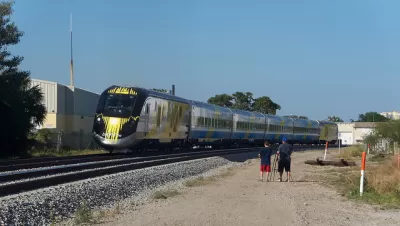
"Brightline plans to start service between Fort Lauderdale and Miami in August or September, Brightline marketing officer Julie Edwards told the Urban Land Institute for Southeast Florida and the Caribbean" on March 10, report Jennifer Sorentrue and Tony Doris for the Palm Beach Post.
Travel between West Palm Beach and Miami will be about an hour, with trains not exceeding 79 miles per hour. Ticket prices haven't been determined yet. See map (pdf) showing service area.
Brightline is "anticipating a grand opening and official launch of the train service in September" after service to Miami has been launched, according to All Aboard Florida, the company behind the new service.
More good news: Brightline's second trainset arrived on Monday from Sacramento, California, where they are manufactured at a Siemens USA factory, notes a press release. Each trainset is composed of four passenger cars and two locomotives.
“It is exciting to reach another important Brightline milestone as BrightPink [named for color of cars] arrives in Florida,” said Brightline CEO David Howard. The first trainset, "BrightBlue", arrived in January.
"In all, five trains are expected to arrive in South Florida before the company launches the first leg of its passenger service this summer," add Sorentrue and Doris.
Eventually, Brightline plans to expand service north to Orlando.
Track work for the second phase of the project, which runs between West Palm Beach and Orlando, has not yet begun. Treasure Coast leaders are challenging that stretch of the project, and have filed a federal lawsuit to block bonds that the company had planned to use to pay for the construction.
And that brings up the bad news for the privately funded railway — new legislation "could threaten its expansion to Orlando and other points across the state," reports Sorentrue on Tuesday.
The bill (SB 386), dubbed the Florida High-Speed Passenger Rail Safety Act, cleared its first hurdle on Tuesday, winning support from the Senate’s Committee on Transportation.
“What this bill does is create a climate for many years of legal and administrative challenges,” Rusty Roberts, vice president of government affairs for All Aboard Florida, said.
According to the legislative analysis (pg. 7 of 23 [pdf]), the trains will travel at high speeds for the second phase of construction to connect to Orlando.
According to (All Aboard Florida), Brightline will travel at speeds between 79 and 125 miles per hour. Between Miami and West Palm, the trains will travel up to 79 mph; between West Palm to Cocoa, up to 110 mph; and from Cocoa to Orlando, up to 125 mph...
The bill lays out a series of requirements that rail operators must meet. A major issue is if it targets one company, which would be unconstitutional. Sen. Debbie Mayfield, R-Vero Beach, said it doesn't.
“This is not about a particular high-speed passenger train,” Mayfield said. “This is about setting a framework for Florida.”
Hat tip to AASHTO Daily Transportation Update.
Read the full story: Brightline to start service in July between WPB and Ft. Lauderdale
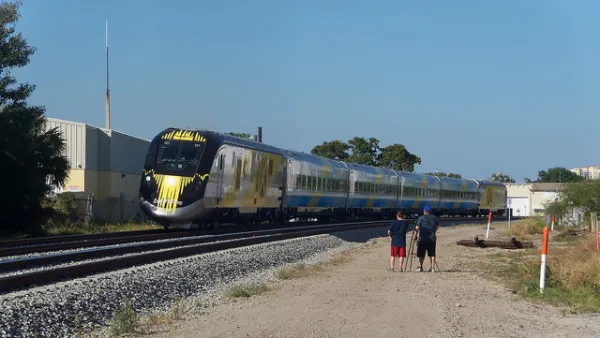
Florida's Brightline to Break Ground on Delayed Orlando Leg
The second phase of the highly anticipated Brightline express train service is finally moving forward after unanticipated delays.
Fatalities Mount from Brightline, South Florida's New Higher-Speed Train Service
A 51-year-old bicyclist became the second fatality in the first week of revenue service. It was the fourth fatality since the summer for the diesel train, which operates from West Palm Beach to Fort Lauderdale.
All Aboard Florida's Brightline Set to Launch this Month
The privately funded, diesel-powered trains will run at speeds up to 79 mph between West Palm Beach and Fort Lauderdale, with an extension to Miami opening early next year. Real estate development is key to profitability.

Planetizen Federal Action Tracker
A weekly monitor of how Trump’s orders and actions are impacting planners and planning in America.

California plans to bury El Niño’s downpour
If the state plays its cards right, it may be able to store a billion acre-feet of El Niño’s water in aquifers.

Desperate measures: Advocates weigh draining Lake Powell to fill Colorado River
Draining the reservoir could reduce evaporation losses by a couple hundred thousand acre-feet.

Mamdani’s pied-à-terre tax survives legal challenge
A panel of judges found that the plaintiffs failed to demonstrate injury as a result of New York City's implementation of the tax.

Eastern Nebraska is running out of electricity
Data centers and electrification are straining eastern Nebraska’s grid, throttling economic development.

Seattle passes record-breaking transit services expansion
Proposition 1 will double the city’s transit tax to add 95,000 more bus trips and preserve 180,000 bus trips annually.

FREE Course: Walkable City 1: Why Walkability?
After describing his path towards focusing on walkability as the essence of good planning, Jeff Speck marches through his five principal reasons for making more walkable places.
Reinventing Malls: Planning Alchemy—Turning Gray Fields Into Gold
The course focuses on the opportunities and imperatives that shape reinvention of mall sites.

City of Rosemead
Rutgers University, Edward J. Bloustein School of Planning and Public Policy
One Hundred Miles
Hunter College, City University of New York (CUNY)
The Architects Foundation
University of Cincinnati Online
City of Cambridge
Montrose County
The Pocatello Development Authority