Pulling in community members and a network of local nonprofits, Phoenix's "Spaces of Opportunity" is an attempt to make urban farming something more than a catchphrase.


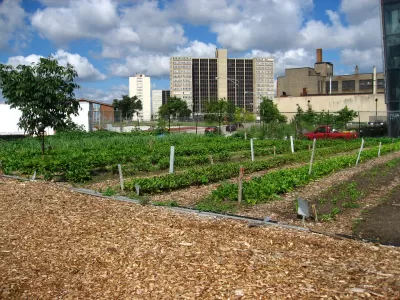
The dream is to make local produce available in a suburban food desert. As for the implementation, we'll have to see. For its urban farming project in Phoenix, called "Spaces of Opportunity," DSGN AGNC used a hybrid design approach: bottom-up as well as top-down. Sam Lubell writes, "the firm comes up with a plan, but then the community inevitably changes it to better meet their needs, and then the designers scramble to catch up with an adjusted plan."
The overall plan involves taking a parcel of land and laying out "segmented plots for community gardens and incubator farms. Master farmers will teach apprentices agrarian skills, helping them progress so they can get their own plots to work." Local nonprofits, philanthropists, and community members are actively honing the design, which has broadened to include multiple community-focused uses.
And that's probably a good thing. "Incorporating so many types of uses has helped not only with interest, but also with fundraising." With construction currently underway, DSGN AGNC principal Quilian Riano hopes this model will help urban farming take off in earnest.
Read the full story: Urban farming in suburban Phoenix becomes the basis for an entire community hub
Urban Farming Addressing Hunger (and More) in Pittsburgh
Urban farming provides opportunities to increase food security in addition to other benefits.
New Report Proposes Ways to Combat L.A.'s "Food Deserts"
A new report from The Los Angeles Food Policy Task Force calls for the government to take steps to increase accessibility to local, healthy food in urban areas.
The Local Food Movement Goes Online
Online tools designed to connect local farmers with consumers are helping sustain the local food and urban agriculture movements.

Planetizen Federal Action Tracker
A weekly monitor of how Trump’s orders and actions are impacting planners and planning in America.

California plans to bury El Niño’s downpour
If the state plays its cards right, it may be able to store a billion acre-feet of El Niño’s water in aquifers.

Desperate measures: Advocates weigh draining Lake Powell to fill Colorado River
Draining the reservoir could reduce evaporation losses by a couple hundred thousand acre-feet.

Mamdani’s pied-à-terre tax survives legal challenge
A panel of judges found that the plaintiffs failed to demonstrate injury as a result of New York City's implementation of the tax.

Eastern Nebraska is running out of electricity
Data centers and electrification are straining eastern Nebraska’s grid, throttling economic development.

Seattle passes record-breaking transit services expansion
Proposition 1 will double the city’s transit tax to add 95,000 more bus trips and preserve 180,000 bus trips annually.

FREE Course: Walkable City 1: Why Walkability?
After describing his path towards focusing on walkability as the essence of good planning, Jeff Speck marches through his five principal reasons for making more walkable places.
Reinventing Malls: Planning Alchemy—Turning Gray Fields Into Gold
The course focuses on the opportunities and imperatives that shape reinvention of mall sites.

City of Rosemead
Rutgers University, Edward J. Bloustein School of Planning and Public Policy
One Hundred Miles
University of Michigan School for Environment and Sustainability (SEAS)
Hunter College, City University of New York (CUNY)
The Architects Foundation
City of Cambridge
Montrose County
The Pocatello Development Authority