A bill proposed by a Republican lawmaker in North Dakota will shift forgive motorists any liability if they to run over pedestrians "negligently" occupying a freeway.


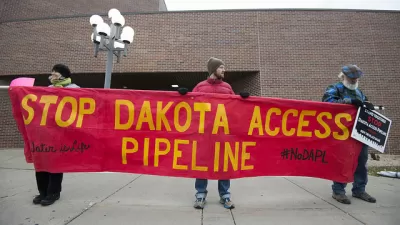
"Republican lawmakers in the state introduced a bill last week in the legislature that would not hold motorists liable for negligently running over someone obstructing a roadway," reports Justin Boggs. "The bill was introduced in response to a year of protests over a proposed pipeline near the Standing Rock Indian Reservation."
Nick Smith broke the news for the Bismark Tribune, reporting that Rep. Keith Kempenich, R-Bowman, wrote the legislation. The article quotes Kempenich's own words to describe the purpose of the bill: "It’s shifting the burden of proof from the motor vehicle driver to the pedestrian."
Smith provides additional details about the role of the North Dakota Highway Patrol in writing and enforcing the potential law. Boggs notes that the North Dakota House Transportation Committee will hear the bill later this week.
Read the full story: Motorist liability introduced in response to pipeline protests

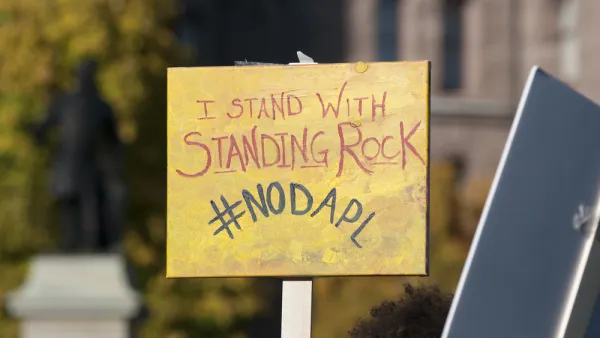
North Dakota House Rejects Law Legalizing Vehicular Violence Against Protestors
The North Dakota House of Representatives rejected a law designed to make it easier for drivers to run over protestors.

Following Study, Army Corps Needs More Study to Decide Dakota Access Route
As the protests over the Dakota Access Pipeline continue, so does the legal wrangling.
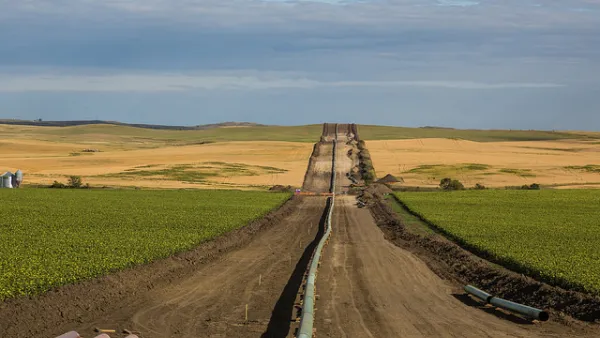
Dakota Access Protest Dealt Legal Setback
The federal judge ruled against a challenge that would have halted construction on the $3.8 billion pipeline project connecting North Dakota to Illinois.

Planetizen Federal Action Tracker
A weekly monitor of how Trump’s orders and actions are impacting planners and planning in America.

California plans to bury El Niño’s downpour
If the state plays its cards right, it may be able to store a billion acre-feet of El Niño’s water in aquifers.

Desperate measures: Advocates weigh draining Lake Powell to fill Colorado River
Draining the reservoir could reduce evaporation losses by a couple hundred thousand acre-feet.

Chicago Avenue bridge construction delays enrages city leaders
The bridge has been closed since 2025. The city originally aimed to re-open it in December, and now expects to finish construction in 2027.

NYC bus network redesign speeds up Queens buses
Rush routes have seen a 4.6% speed increase after the redesign.

California High-Speed Rail Authority picks trainset manufacturer
The California High-Speed Rail Authority aims to start servicing passengers by 2033.

FREE Course: Walkable City 1: Why Walkability?
After describing his path towards focusing on walkability as the essence of good planning, Jeff Speck marches through his five principal reasons for making more walkable places.
Reinventing Malls: Planning Alchemy—Turning Gray Fields Into Gold
The course focuses on the opportunities and imperatives that shape reinvention of mall sites.

City of Rosemead
Rutgers University, Edward J. Bloustein School of Planning and Public Policy
One Hundred Miles
Hunter College, City University of New York (CUNY)
The Architects Foundation
University of Cincinnati Online
City of Cambridge
Montrose County
The Pocatello Development Authority