A new City Council has ushered in a new agenda for the city of Anaheim. Not on that agenda is a controversial proposal for a streetcar connecting Disneyland, the city's convention center, and the Anaheim Regional Transportation Intermodal Center.


An editorial by Orange County Register describes the recent political shift on the Anaheim City Council by taking inventory of the new items getting added to the city's political agenda as well as some of the old items getting axed. The most controversial projects that have been brought to a close, according to the editorial, are the city’s luxury hotel subsidy program and the Anaheim Streetcar.
Joseph Pimentel reported on the final days of the streetcar project in a separate article. The editorial welcomes the end of the streetcar project, arguing that the streetcar "is an archaic mode of transportation, incapable of adapting to shifts in demand or population, and case studies from other systems, including those held up as models, often don’t measure up." The editorial also argues that a proposed streetcar project in nearby Santa Ana should meet a similar fate.
FULL STORY: Anaheim streetcar finally put to an end

OC Streetcar Breaks Ground After Receiving Full Funding Grant Agreement
It's only the third full funding grant administration signed by Transportation Secretary Elaine Chao. The $149 million capital investment grant will help fund the 4-mile modern streetcar line from Santa Ana to Garden Grove in Orange County, Calif.
Plans Advance for Orange County Streetcar
The $289 million streetcar would serve the cities of Santa Ana (population 329,00), county seat and second densest in California after San Francisco, and Garden Grove (population 170,000) on a 4.1-mile route. Service could begin 2020.
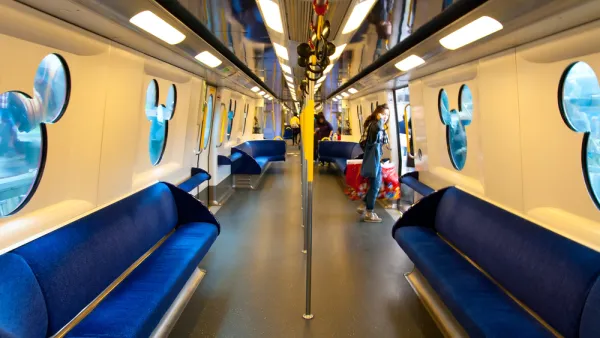
Disney's Political Donations Increase as Anaheim Considers a Streetcar
Disney says its supports pro-business candidates for City Council in Anaheim, but some see a proposed streetcar as the connection behind an uptick in the company's local political support.

Planetizen Federal Action Tracker
A weekly monitor of how Trump’s orders and actions are impacting planners and planning in America.

The state-sanctioned urbicide of Austin
People don’t kill cities. Freeways do.

US to reduce Colorado River water deliveries to Mexico
A new Colorado Treaty amendment reduces Mexico’s Colorado River water allocation by 250,000 acre feet.

Mamdani overhauls NYC's Vision Zero plan with 100 new policy goals
The overhaul aims to reduce traffic deaths and make streets safer for pedestrians, cyclists and drivers through lower speed limits, new safety infrastructure and more.

Amtrak not solely to blame for New Jersey commuter rail's unreliability, report finds
A new study from the Garden State Initiative found that NJ Transit’s budget grew 20% across a 4 year period, but reliability declined significantly over the same period.

EPA erases limits on planet-warming pollution from power plants
Under Monday’s plan, power plants would still have some limits on how much mercury, arsenic and other contaminants they can emit.

FREE Course: Walkable City 1: Why Walkability?
After describing his path towards focusing on walkability as the essence of good planning, Jeff Speck marches through his five principal reasons for making more walkable places.
Reinventing Malls: Planning Alchemy—Turning Gray Fields Into Gold
The course focuses on the opportunities and imperatives that shape reinvention of mall sites.

Eagle County Government
Harvard University Graduate School of Design
Nashville Planning Department
The Architects Foundation
University of Cincinnati Online
The Pocatello Development Authority
The Urban Renewal Agency of the City of Pocatello
Journal of the American Planning Association