New York's lack of sunlight might be overstated, but the New York Times mapped the shadows cast by every building on every block of the city just to be sure.



The New York Times has produced a series of artful maps that illustrates "all of the shadows produced by thousands of buildings in New York City over the course of one day."
Quoctrung Bui and Jeremy White provide the context for the maps, noting that in most parts of America, "sunlight is not debated the way it is in New York, where the city’s thirst for living space, working space and economic growth has turned the sun into a virtual commodity."
Planning, and specifically zoning, has been at the center of the debate for decades, according to the article.
The city’s first attempt at light preservation was through a setback rule. As successive buildings grew taller, they would have to be continually set back a couple of feet from the street (like the Empire State Building), producing the classic wedding-cake style of skyscraper. Decades later, in the 1960s, the city overhauled this rule in favor of a floor-area ratio model, which tended to produce tall, narrow structures with open plazas at the base (like the Seagram Building).
The article includes three maps, presenting the variations between the seasons.
Read the full story: Mapping the Shadows of New York City: Every Building, Every Block

Friday Eye Candy: A Sorely-Needed Map of New York City Neighborhoods
Neighborhoods don't get the same official boundaries as cities, counties, states, and countries. So how do we know where one neighborhood ends and another begins?
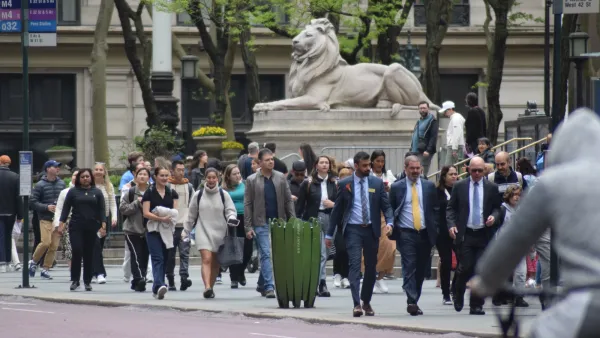
See the First Complete Map of NYC Walking Traffic
A new model of pedestrian routes and activity can help NYC planners make more informed decisions about transportation infrastructure and pedestrian safety improvements.
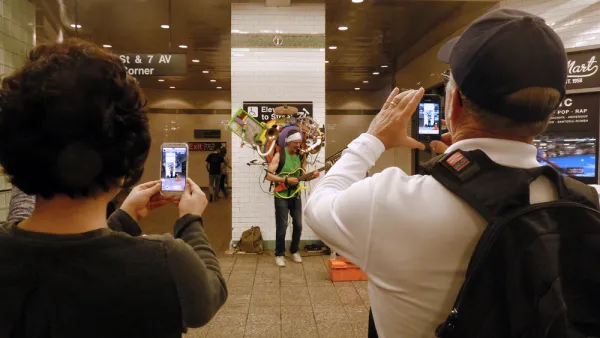
Friday Eye Candy: The Theatricality of the Subway
A new book of photography amplifies what was already there.

Planetizen Federal Action Tracker
A weekly monitor of how Trump’s orders and actions are impacting planners and planning in America.

California plans to bury El Niño’s downpour
If the state plays its cards right, it may be able to store a billion acre-feet of El Niño’s water in aquifers.

Desperate measures: Advocates weigh draining Lake Powell to fill Colorado River
Draining the reservoir could reduce evaporation losses by a couple hundred thousand acre-feet.

Los Angeles just elected an urban planner as its mayor
Transportation analysts are optimistic that Raman will be more aggressive in addressing transit issues than Bass.

Mamdani’s pied-à-terre tax survives legal challenge
A panel of judges found that the plaintiffs failed to demonstrate injury as a result of New York City's implementation of the tax.

Eastern Nebraska is running out of electricity
Data centers and electrification are straining eastern Nebraska’s grid, throttling economic development.

FREE Course: Walkable City 1: Why Walkability?
After describing his path towards focusing on walkability as the essence of good planning, Jeff Speck marches through his five principal reasons for making more walkable places.
Reinventing Malls: Planning Alchemy—Turning Gray Fields Into Gold
The course focuses on the opportunities and imperatives that shape reinvention of mall sites.

City of Rosemead
Rutgers University, Edward J. Bloustein School of Planning and Public Policy
One Hundred Miles
University of Michigan School for Environment and Sustainability (SEAS)
Hunter College, City University of New York (CUNY)
The Architects Foundation
City of Cambridge
Montrose County
The Pocatello Development Authority