Founded in 1928, the fascist new town of Arborea (formerly known as Mussolinia) still shows hints of the divergence between the traditional towns of Sardinia and the modernist leanings of its founders.


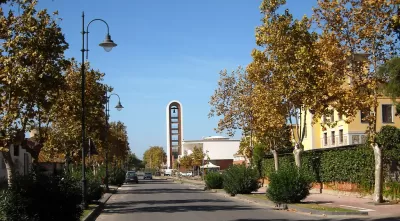
Writing in Wallpaper, Owen Hatherley accompanies Oliviero Olivieri's photographic exploration of the Sardinian town of Arborea—a 'fascist new town' established on drained marshland in a process, he describes as a "clear colonisation within the Kingdom of Italy itself, where Sardinia was always somewhat apart, linguistically and culturally." The town's straight roads and unusual vernacular cue the visitor to the separate planning processes that helped to form Arborea. It was the first of multiple fascist new towns created in the first half of the 20th century throughout Italy.
You notice something is different when you drive from the nearest railway station, at Marrubiu, to the new town: suddenly the roads are rigidly straight, running alongside canals in rich arable land, in the shadow of harsh, bare mountain ranges.
...
The architect of Mussolinia, between 1928 and 1939, was Giovanni Battista Ceas, a critic and historian as well as a designer. Accordingly, there’s very little trace in the first clutch of buildings of the more modernising trends in Fascist Italy, such as the monumental dreams of Futurist architects like Antonio Sant’Elia or the cold rationalism of Giuseppe Terragni. A hospital, a school, a town hall and a police station are in an invented vernacular bearing little resemblance to Sardinian architecture.
Read the full story: Planned vision: Arborea offers up clues to its architecturally ambitious past as Mussolinia

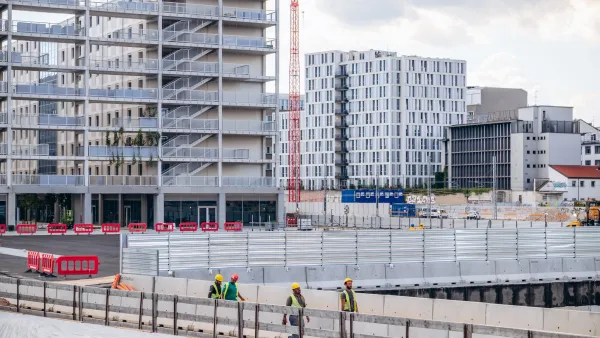
Milan’s Olympic Athletes’ Village is Designed for Reuse
This year’s athlete housing is designed specifically to be repurposed as student housing after the games.
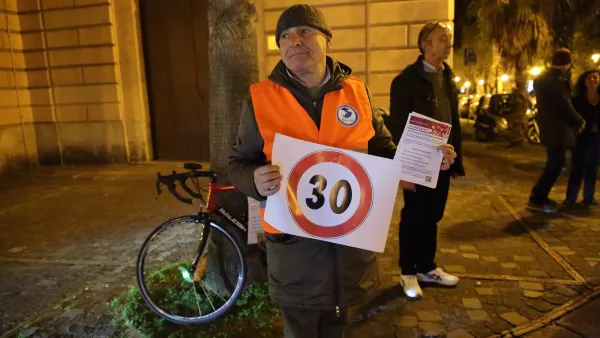
Rome is Latest European Capital to Drop Speed Limit to 30KPH
Traffic fatalities in Bologna, the first major Italian city to lower their speed limit, dropped by 50 percent in the first year.
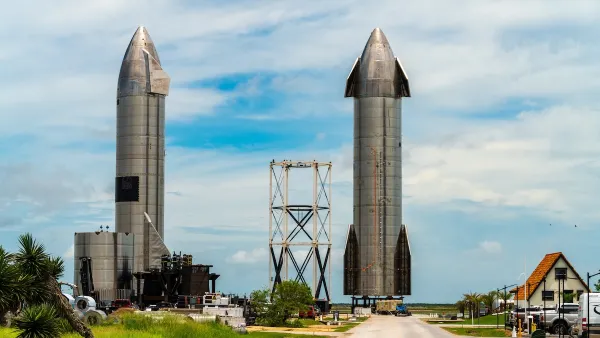
Company Towns: A Fraught 19th Century Idea is Getting a Second Life
From Lowell to Elon Musk’s Starbase, we trace the rise, fall, and resurgence of company towns.

Planetizen Federal Action Tracker
A weekly monitor of how Trump’s orders and actions are impacting planners and planning in America.

Amtrak, CN end decades-long dispute with eight-year agreement
The new operating agreement establishes an updated framework for the companies to work together, including processes to resolve disputes.

Judges permit Denver to divert 77,000 acre feet from the Colorado River for reservoir expansion
Overuse and climate change have caused the Colorado River’s water levels to plummet.

NYC DOT wants faster, more permanent street upgrades
The city is examining ways to build more concrete infrastructure without getting entangled in 'decades-long' projects.

'Something we’ve never seen before:' rising utility rates could strain city finances nationwide
Data centers, climate change and other factors have caused utility rates in the United States to increase by 38% since 2020.

Trump to overrule local leaders, lease millions of acres of America’s Pacific Island territories’ seafloors to mining companies
International law says that the Indigenous people of America’s territories have a right to prior and informed consent regarding projects that impact their countries.

FREE Course: Walkable City 1: Why Walkability?
After describing his path towards focusing on walkability as the essence of good planning, Jeff Speck marches through his five principal reasons for making more walkable places.
Reinventing Malls: Planning Alchemy—Turning Gray Fields Into Gold
The course focuses on the opportunities and imperatives that shape reinvention of mall sites.

Harvard University Graduate School of Design
KFH Group Inc.
Greater Baltimore Committee
The Architects Foundation
University of Cincinnati Online
The Pocatello Development Authority
The Urban Renewal Agency of the City of Pocatello