Rebuilding and repairing New York City after Hurricane Sandy shows how climate change can exacerbate existing equity problems and that such disasters must spur efforts to rebuild fairly, not entrench existing problems.



Michelle Chen investigates the ongoing rebuilding process in New York City and the surrounding areas after Hurricane Sandy in a piece for The Nation. She talks about how efforts in the city are focused, not only on immediate repairs but also, "To safeguard cities from future disasters, cities need to improve infrastructural protection and promote ecologically conscious urban planning. Locally this means creating resilient local food, transit and energy systems that are responsive to global environmental pressures and accountable to local communities," Chen argues.
Strengthening the city is, however, only one piece of the work, another is ensuring that those most vulnerable to such disasters don't have their existing problems redoubled by the cities efforts. "New Orleans represents the nightmare scenario of a city that has struggled to implement economic- and environmental-justice measures after environmental disaster left poor communities of color displaced, exposed to economic exploitation, and politically marginalized in the rebuilding efforts," Chen writes.
These considerations will apply to issues all over the world. "On a global scale, both adaptation and mitigation are twin pillars of the Paris climate treaty, but the question of economic fairness looms large over both."
Read the full story: There’s a Right Way—and a Wrong Way—for Cities to Mitigate Climate Change

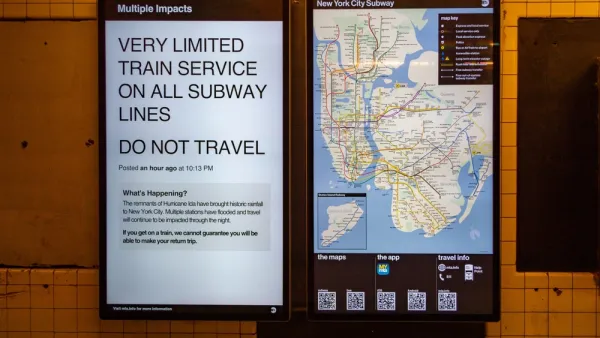
Ida Takes a Deadly Toll in the Northeast
Hurricane Ida passed through New Orleans, knocking out power causing extensive damage along the Gulf Coast. Then it moved to the Northeast, killing dozens of people with flooding caused by heavy rains.
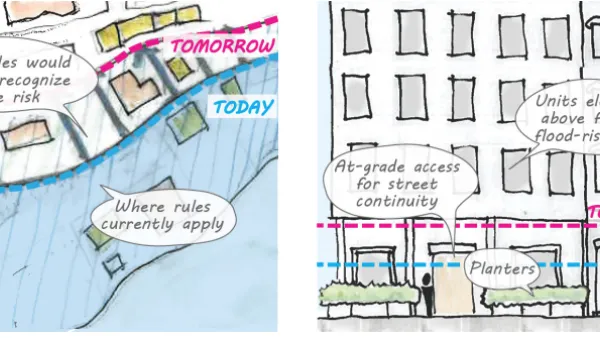
Proposed Citywide Rezoning Would Layer Resilience in New York City
With 520 miles of coastline, New York City is ready to implement the lessons of Hurricane Sandy in the zoning code for the entire city.
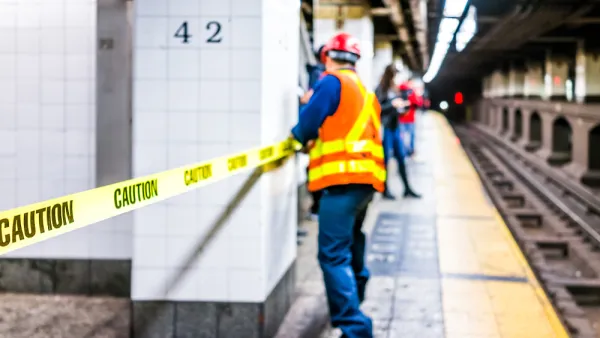
Why New York City's Flooding Its Own Subway Entrances
MTA reassured disoriented New Yorkers that it's flooding subway entrances on purpose, to test barriers that it hopes will guard the system against another Sandy.

Planetizen Federal Action Tracker
A weekly monitor of how Trump’s orders and actions are impacting planners and planning in America.

Amtrak, CN end decades-long dispute with eight-year agreement
The new operating agreement establishes an updated framework for the companies to work together, including processes to resolve disputes.

Judges permit Denver to divert 77,000 acre feet from the Colorado River for reservoir expansion
Overuse and climate change have caused the Colorado River’s water levels to plummet.

Atlanta City Council unanimously backs $3.5 billion Beltline light rail project
The resolution was drafted after Atlanta Mayor Andre Dickens pulled support for the Atlanta Streetcar extension last year.

SEPTA to bring nearby frequent transit to over 1 million new riders as part of decade-long plan
The agency's Accelerate plan will also bring frequent transit to twice the amount of jobs that are currently located near it.

NYC plants over 18,000 trees, the most new foliage in a decade
Many of the trees were planted in communities vulnerable to extreme heat.

FREE Course: Walkable City 1: Why Walkability?
After describing his path towards focusing on walkability as the essence of good planning, Jeff Speck marches through his five principal reasons for making more walkable places.
Reinventing Malls: Planning Alchemy—Turning Gray Fields Into Gold
The course focuses on the opportunities and imperatives that shape reinvention of mall sites.

City of Thousand Oaks
City of Wisconsin Rapids
Harvard University Graduate School of Design
The Architects Foundation
University of Cincinnati Online
The Pocatello Development Authority
The Urban Renewal Agency of the City of Pocatello