With Donald Trump set to take office January 20th, some cities are already planning to defy his deportation plans.



During his campaign, Donald Trump initially promised to deport 11 million undocumented immigrants. Since winning the election a few weeks ago he has already backed down from that promise, but Natalie Delgadillo reports in CityLab that the president elect, "Appears intent on deporting some 3 million undocumented immigrants (still the most in history, but far less than his original vow to deport 11 million)." To accomplish that record deportation and eclipse the previous high set by Obama, Trump will need the cooperation of a number of different groups and bureaucracies. "On the campaign trail, Trump promised to cut off federal funding to localities that refuse to cooperate with federal immigration authorities in enforcing immigration law," Delgadillo tells us.
Even with that threat of reduced funding, many of the mayors and prominent official in America's largest cities have already publicly stated their intentions to defy Trump's deportation plans. These "sanctuary cities" include: New York, Los Angeles, Chicago, Philadelphia, San Francisco, Washington D.C., Seattle, and Providence, among others. San Francisco's mayor, Ed Lee, said in a tweet, "Being a sanctuary city is in our DNA. San Francisco will never be anything other than a sanctuary city."
The consequences of this conflict could be great. The Pew Research Center estimated there were approximately 11.1 million undocumented immigrants in the United States, down about a million since its peak in 2007. If more than one in four of those people were to be forcibly removed from the country, it would affect the landlords who rent to them, businesses that employ them and the families they support. The ripple effects would create huge impacts on the economic output, schools, and housing markets. If Trump is to find a way to follow through on his threat to cut off funding to cities, the consequences would be severe. "In San Francisco alone, city leaders estimate they receive about one billion dollars a year in federal funding for everything from infrastructure to education," Delgadillo reports.
Read the full story: The Cities Pledging to Defy Trump on Immigration

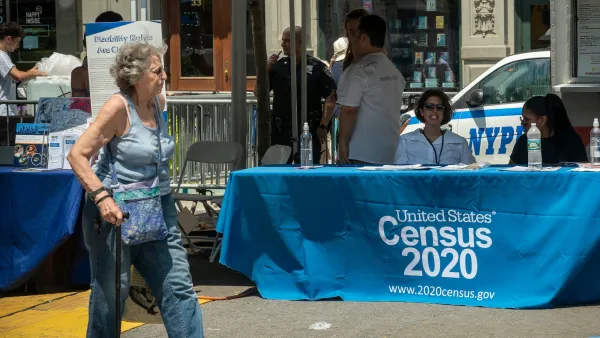
Two Lawsuits Aim to Strip Immigrants, Privacy Protections From US Census
The two cases could have major impacts on how Americans are counted in the next census.
How Land Use Policy Helped Turn California Blue
As recently as a half-generation ago, California passed anti-immigrant laws, routinely elected Republican politicians, and wallowed in land use laws—like Prop. 13—enacted by conservatives. Manuel Pastor explains California's change of heart.
Is Houston a City of the (Demographic) Future?
Bucking Texas political stereotypes, Houston is standing by its immigrant community. One reason: the city is one of country's most racially diverse.

Planetizen Federal Action Tracker
A weekly monitor of how Trump’s orders and actions are impacting planners and planning in America.

Amtrak, CN end decades-long dispute with eight-year agreement
The new operating agreement establishes an updated framework for the companies to work together, including processes to resolve disputes.

Northwest rail fans eager for Sept. 30 debut of Amtrak’s Airo fleet
Get ready for that new train smell and more seats. But they won’t go faster or run more frequently on the Cascades route in Washington and Oregon.

LAX SkyLink opening delayed again, contractor won’t commit to new deadline
The project was supposed to open its doors to the public in 2023.

Caltrain may slash over one-third of its stations
If Bay Area voters reject two transit tax measures, Caltrain, BART and AC Transit will see steep service cuts.

A 'dangerous' precedent: North Carolina successfully pressures communities into voting for toll roads
Two mayors resigned from the Charlotte Regional Transportation Planning Organization after it voted in favor of the toll roads.

FREE Course: Walkable City 1: Why Walkability?
After describing his path towards focusing on walkability as the essence of good planning, Jeff Speck marches through his five principal reasons for making more walkable places.
Reinventing Malls: Planning Alchemy—Turning Gray Fields Into Gold
The course focuses on the opportunities and imperatives that shape reinvention of mall sites.

City of Thousand Oaks
City of Wisconsin Rapids
Harvard University Graduate School of Design
The Architects Foundation
University of Cincinnati Online
The Pocatello Development Authority
The Urban Renewal Agency of the City of Pocatello