Comprehensive plans can be big and unwieldy. Luckily for Washington, D.C., there are two maps that unlock of the plan's meaning.


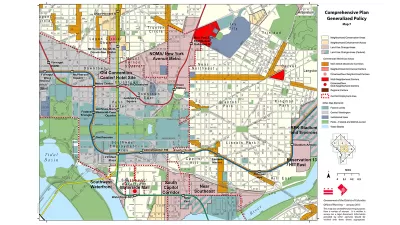
David Whitehead sifts through the 600 pages of the D.C. Comprehensive Plan and identifies the two maps that provide access to the plan's core ideas.
"DC has a giant planning document called the Comprehensive Plan. Most of it is super dense and complicated, but its goal is to lay the foundation for many city-wide decisions, in particular decisions on land use," explains Whitehead. "Partially because of its size and obscurity, many people just focus on two maps that exist as part of the Comp Plan: the Future Land Use Map (FLUM), and the Generalized Policy Map."
Whitehead then digs into both of the two maps, illuminating the key ideas that will help guide an understanding of these already most accessible parts of the D.C. Comprehensive Plan.
But then, there's a caveat. According to Whitehead, "[t]here's one big issue with both of these maps: they tend to preserve the status quo—more specifically, the status quo of 2006, which is when the Comp Plan was created." Luckily, Whitehead reports that the D.C. Office of Planning is "organizing an effort to amend and update the Comprehensive Plan."
FULL STORY: These two maps are the guides to your neighborhood's future. Here's what you should know about them.

D.C. Comprehensive Plan Update Needs Equity Improvements, Report Says
The new D.C. Office of Equity has produced an evaluation of proposed changes to the D.C. Comprehensive Plan.

Comprehensive Plan Update Stokes Controversy in D.C.
Complex political dynamics are mustering for a showdown over D.C.'s comprehensive plan.
Why Have ADUs Proliferated in Portland, Lagged in D.C.?
A new report by the Urban Institute examines the consequences of small differences in land use regulations.

Planetizen Federal Action Tracker
A weekly monitor of how Trump’s orders and actions are impacting planners and planning in America.

The state-sanctioned urbicide of Austin
People don’t kill cities. Freeways do.

US to reduce Colorado River water deliveries to Mexico
A new Colorado Treaty amendment reduces Mexico’s Colorado River water allocation by 250,000 acre feet.

5 New England states march closer to 800 megawatt wind energy project
Securing federal approval for the project may be complicated under the Trump administration, which has historically been hostile towards domestic wind power.

Baltimore to break ground on $50 million Transit Priority Project
The project will bring faster bus trips, safer streets and better bike connections to Baltimore.

Airbnb launches $250 million 'last-dollar financing' housing accelerator, makes first investment in Austin
The company will put $6.4 million towards affordable housing development in Texas’ capital.

FREE Course: Walkable City 1: Why Walkability?
After describing his path towards focusing on walkability as the essence of good planning, Jeff Speck marches through his five principal reasons for making more walkable places.
Reinventing Malls: Planning Alchemy—Turning Gray Fields Into Gold
The course focuses on the opportunities and imperatives that shape reinvention of mall sites.

Eagle County Government
Harvard University Graduate School of Design
Nashville Planning Department
The Architects Foundation
University of Cincinnati Online
The Pocatello Development Authority
The Urban Renewal Agency of the City of Pocatello
Journal of the American Planning Association