Austin Office of Sustainability upgrades transparency with a new online resource.



"If you cannot measure it, you cannot improve it," goes an old quote from Lord Kelvin, the 19th century mathematical physicist; the quote was adopted more recently by those who sought to change large organizations and bureaucracies.
Austin's Office of Sustainability measures 50 variables from the city's departments, but this information had previously been available only in annual reports. In order to make their work more accessible to a wider range of people, the department undertook an initiative to put all of this information into one updatable dashboard. This online tool could provide a dynamic resource updated with information on the city’s performance relating to sustainability goals. "The dashboard tracks 50 indicators across 10 categories, including food and health, energy, water, built environment, and zero waste." Reports Jen Kinney of Next City.
Though the final product may be digital, the collection of the data that builds it is still decidedly analogue. Kinney reports that the department seeks to automate the process moving forward, getting the data from the city to the people as quickly and accurately as possible.
Read the full story: Austin Gets More Transparent About Sustainability

New Green Development Rules Take Effect in Austin
The city updated its development code to include more robust protection for local wetlands and stricter sustainable stormwater infrastructure requirements.
Racial Equity and Urban Climate Action
Equity is hardly mentioned in most urban climate action plans, but a few cities, like Austin, Texas, are leading the charge to center in equity in both the process and content of climate planning.

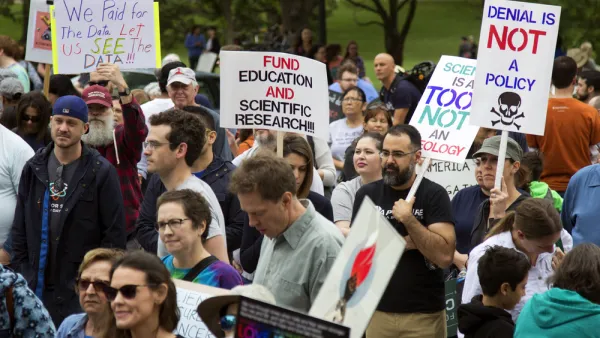
Trump Administration's Draft Budget Raises New Concerns About Data Collection
President Trump has made no secret of his disdain for many of the traditional data points used to represent the health and prosperity of the country. The budgetary process offers an opportunity to match words with action.

Desperate measures: Advocates weigh draining Lake Powell to fill Colorado River
Draining the reservoir could reduce evaporation losses by a couple hundred thousand acre-feet.

Eastern Nebraska is running out of electricity
Data centers and electrification are straining eastern Nebraska’s grid, throttling economic development.

Malls are becoming the midtowns of the future
Mall and office park redevelopments are a generational opportunity to create new nodes of urbanity.

NYC breaks ground on anti-flooding infrastructure project
New York City's new system will reduce stormwater flows to local sewers by 90%.

One Kentucky town’s secret to affordable housing
The Smoketown Community Land Trust has already built seven affordable homes for community members.

Houston gains petal-shaped cooling infrastructure to make streets more ‘delightful’
The city has installed the pavilions along 15 blocks in Houston.

FREE Course: Walkable City 1: Why Walkability?
After describing his path towards focusing on walkability as the essence of good planning, Jeff Speck marches through his five principal reasons for making more walkable places.
Reinventing Malls: Planning Alchemy—Turning Gray Fields Into Gold
The course focuses on the opportunities and imperatives that shape reinvention of mall sites.

City of Rosemead
Rutgers University, Edward J. Bloustein School of Planning and Public Policy
One Hundred Miles
University of Michigan School for Environment and Sustainability (SEAS)
Hunter College, City University of New York (CUNY)
The Architects Foundation
City of Cambridge
Montrose County
The Pocatello Development Authority