Los Angeles County Supervisor Mark Ridley-Thomas, a veteran leader at the city, county, and state-level, addresses the funding gaps to address this urgent issue and shares some innovative models being deployed by the county.



On any given night, 115,000 people are homeless in California. It is the largest homeless population in the United States. In an exclusive interview with The Planning Report, Los Angeles County Supervisor Mark Ridley-Thomas discusses his personal efforts to address Los Angeles’ 50,000 homeless individuals through working on rapid rehousing and increasing social services. Over the past year, Supervisor Mark Ridley-Thomas has used his platform to push (unsuccessfully) Governor Jerry Brown to establish a state of emergency for homelessness, opening up critical funding for rapid rehousing and mental health services.
“The polling is clear, stated Supervisor Ridley-Thomas, "whether they were done by Republicans or Democrats did not make any difference—it was made abundantly clear that homelessness is the top-tier issue for the people of this county.”
In response, the City of Los Angeles has put Proposition HHH on the November ballot, a measure that would allow the city to borrow money—by issuing bonds—and pay off that debt with a new property tax on commercial and residential properties. Sup. Ridley-Thomas has endorsed Prop. HHH and is working to create an additional funding stream that would help address shortages in providing mental health and clinical services to individuals transitioning into housing. Sup. Ridley-Thomas outlined his plans to “aim toward the March 2017 ballot with a quarter-cent sales tax… [to] address the services gap—mental health services and recuperative care. Multidisciplinary teams will go out into the community to do the work that is so desperately needed and is so conspicuously absent.”
While discussing current activities to address homelessness, Sup. Ridley-Thomas highlighted the success of the new C3 Teams that have started on Skid Row. Integrated Street Engagement Teams, or C3 Teams, are an innovative county-city-community (C3) partnership that consists of four teams of multidisciplinary individuals.
Sup. Ridley-Thomas explains that on Skid Row, “the Department of Health Services uses C3 to engage, assist and house the 2,000 persons living on the streets. Each C3 team has a nurse, substance use counselor, mental health clinician, peer with lived experience, and Los Angeles Homeless Services Authority outreach worker.”
The results are pretty impressive already. Over the last six months, four C3 integrated teams in Skid Row have conducted daily outreach/engagement and assisted 772 unsheltered homeless residents. 370 persons have been connected to interim housing, a couple hundred are in process for permanent supportive housing, and more than 50 people have received keys and moved into their own housing with services attached.
Sup. Ridley-Thomas’ message is one that Los Angeles citizens are agreeing with, no matter where they fall on the development initiatives currently being publically litigated. As he puts it: “Building new buildings is insufficient. You have to have services in order for people to begin to regain their footing and be constructive contributors to their respective communities.”
Read more about Los Angeles’ next steps to meaningfully reduce homelessness in The Planning Report.
Read the full story: Supervisor Mark Ridley-Thomas Prioritizes LA County’s Homeless


Lack of Federal and State Subsidies Slow Homeless Housing Development in L.A.
Developments funded by Los Angeles' Proposition HHH homeless housing bond has been delayed for three key reasons.
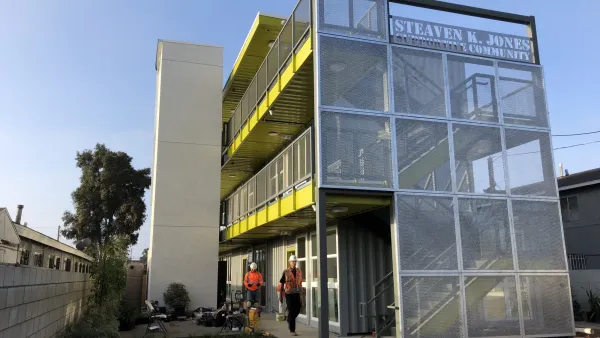
To Reach Goals, L.A. Looks to New Ways to Build Homeless Housing
Los Angeles is grappling with the rising costs of building housing for homeless people. Rethinking the standard process is a way to save time and money.

How L.A. Plans to Address Intersecting Issues of Homelessness and Open Space
In California, agencies are working to redefine enforcement and safety procedures as the number of homeless individuals who seek refuge in vulnerable open or wild landscapes continue to increase.

Planetizen Federal Action Tracker
A weekly monitor of how Trump’s orders and actions are impacting planners and planning in America.

Colorado’s Largest Data Center Could Rise Next to Homes — Without a Public Hearing
The proposed campus would consume 11 times the power of Denver International Airport; as it has across the country, opposition mounts.

US to reduce Colorado River water deliveries to Mexico
A new Colorado Treaty amendment reduces Mexico’s Colorado River water allocation by 250,000 acre feet.

'This is going to be painful:’ Virginia stares down $1.7 billion funding gap for highway maintenance
The state may address the deficit by shifting $290 million from its construction budget to maintenance projects.

Judges permit Denver to divert 77,000 acre feet from the Colorado River for reservoir expansion
Overuse and climate change have caused the Colorado River’s water levels to plummet.

Amtrak, CN end decades-long dispute with eight-year agreement
The new operating agreement establishes an updated framework for the companies to work together, including processes to resolve disputes.

FREE Course: Walkable City 1: Why Walkability?
After describing his path towards focusing on walkability as the essence of good planning, Jeff Speck marches through his five principal reasons for making more walkable places.
Reinventing Malls: Planning Alchemy—Turning Gray Fields Into Gold
The course focuses on the opportunities and imperatives that shape reinvention of mall sites.

KFH Group Inc.
Greater Baltimore Committee
Eagle County Government
The Architects Foundation
University of Cincinnati Online
The Pocatello Development Authority
The Urban Renewal Agency of the City of Pocatello