The city of Sacramento, California, known as the City of Trees, is nearing the finish line on a heavily debated ordinance to create new regulations for the management of trees.



"In the City of Trees, a new ordinance might put more bite in protecting our bark," reports the clever opening of an article by Anita Chabria and Adam Ashton.
The Sacramento City Council recently approved a controversial ordinance that would establish new regulations for "safeguarding, maintaining and removing trees on both public and private land."
"Backers of the new ordinance say it will add protections for about 25,000 trees now excluded from city purview and create a long-term plan for preserving the leafy canopy of 100,000 trees viewed as a defining characteristic of the city," according to Chabria and Ashton.
The ordinance has its opponents, however, and the city had yet to achieve a consensus on the ordinance, days ahead of an expected vote by the City Council. Critics of the plan say it doesn’t go far enough to protect the city's trees.
Among many details reported in the article, Chabria and Ashton note that "the ordinance calls for the city to create a tree master plan to address policy issues such as canopy protections and ways to diversify tree species with ones more suited to the environment." A separate article by Cathy Locke reported the results of the City Council's vote.
Hat tip to Jen Kinney for sharing the news of Sacramento's tree ordinance.
Read the full story: New tree ordinance could give Sacramento’s urban forest closer scrutiny

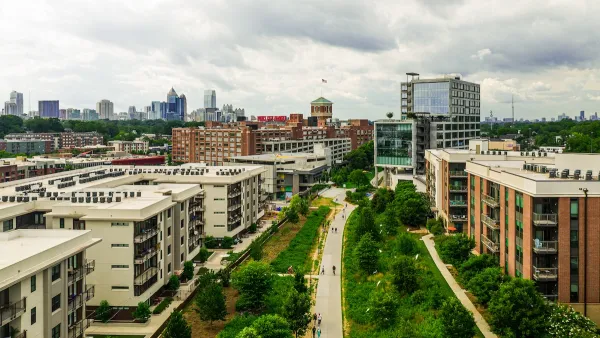
Mapping Georgia’s Urban Forests
Georgia Tech’s latest urban canopy assessment for Atlanta uses high-resolution mapping and a Potential Planting Index to guide data-driven tree preservation.

How Data is Helping Protect Campus Trees
The University of Alabama at Birmingham is using GIS technology, student engagement, and sustainability-driven planning to manage and protect its nationally recognized urban forest.

LA County Releases Draft Community Forest Management Plan
LA County's Chief Sustainability Office just released the discussion draft of Room to Grow, the first Community Forest Management Plan for the county.

Planetizen Federal Action Tracker
A weekly monitor of how Trump’s orders and actions are impacting planners and planning in America.

Amtrak, CN end decades-long dispute with eight-year agreement
The new operating agreement establishes an updated framework for the companies to work together, including processes to resolve disputes.

Judges permit Denver to divert 77,000 acre feet from the Colorado River for reservoir expansion
Overuse and climate change have caused the Colorado River’s water levels to plummet.

Idaho may see an 18% drop in federal surface transit funding — the largest estimated cut in the US
Transit systems in rural communities are much more reliant on federal funding to provide their services.

How ‘post-disaster gentrification’ alters neighborhoods after natural calamities
After hurricanes, fires or other calamities, the original residents of a community are often replaced by younger, wealthier residents.

Maryland local governments examine if they should have more power to raise property taxes
Maryland’s housing market is out of reach for the majority of moderate-income residents.

FREE Course: Walkable City 1: Why Walkability?
After describing his path towards focusing on walkability as the essence of good planning, Jeff Speck marches through his five principal reasons for making more walkable places.
Reinventing Malls: Planning Alchemy—Turning Gray Fields Into Gold
The course focuses on the opportunities and imperatives that shape reinvention of mall sites.

Harvard University Graduate School of Design
KFH Group Inc.
Greater Baltimore Committee
The Architects Foundation
University of Cincinnati Online
The Pocatello Development Authority
The Urban Renewal Agency of the City of Pocatello