A $4.7 billion regional transportation plan died at the hands of suburban interests around Detroit last week. An op-ed describes the action as the same kind of racial disharmony that defined the mid- and late-20 century.



"It's up to Detroit Mayor Mike Duggan and top leaders in four counties to see if they can salvage a $4.7 billion plan for expanded public transportation for the region after the Regional Transit Authority of Southeast Michigan board couldn't come up with the votes to put the proposal before voters," reports Matt Helms.
"The board on Thursday couldn't overcome objections from Macomb and Oakland counties," adds Helms.
Stephen Henderson followed up on the news about the fate of the regional transportation plan by calling out Oakland County Executive L. Brooks Patterson and Macomb County Executive Mark Hackel for continuing a tradition of building literal and figurative walls between demographic groups in Southeast Michigan. Henderson writes that Patterson and Hackel's actions recall a different era of racial politics:
Their rank and disingenuous last-minute opposition to the funding proposal for basic, until-now mythical, regional transit is a call to keep building walls in southeast Michigan. Their assertion that what they’re doing is meant to protect citizens in Macomb and Oakland counties, respectively, is a cynical and erroneous dog whistle, meant to evoke the bad old days of rancor and antagonism in the region.
Henderson's op-ed includes responses to specific points from both Patterson and Hackel's opposition to the plan. Henderson implores his fellow citizens to insist on action from the region's political leadership.
Read the full story: RTA board can't muster votes to OK $4.7B transit plan

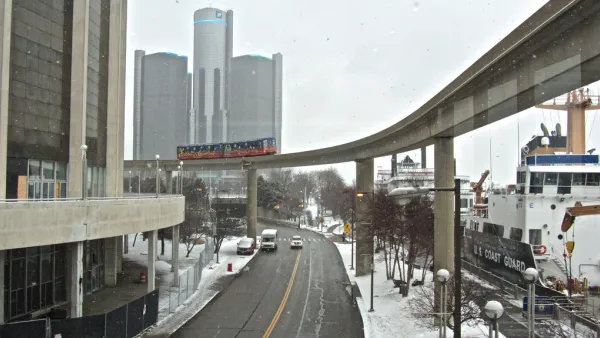
Regional Transit in Detroit: An Idea Whose Time Has Not Yet Come
Transit supporters in the Detroit region suffered a setback last week, but the hope is that they've only lost a battle, not the war, for regional transit.
Metro Detroit's Millage Tax Comes Within Half a Percentage Point of Passing
A $4.6 billion transit plan proposed by the Regional Transit Authority of Southeast Michigan received 49.5 percent of the vote on November 8. The millage tax would have funded bus rapid transit and regional rail within a four-county region.
Detroit's Failed Regional Transit Plan Strikes a Blow to the City's Revival
Voters in the Detroit region had a chance to reverse 40 years of neglect for regional transit. Instead, they kicked the can down the road.

Planetizen Federal Action Tracker
A weekly monitor of how Trump’s orders and actions are impacting planners and planning in America.

The state-sanctioned urbicide of Austin
People don’t kill cities. Freeways do.

Colorado’s Largest Data Center Could Rise Next to Homes — Without a Public Hearing
The proposed campus would consume 11 times the power of Denver International Airport; as it has across the country, opposition mounts.

Judges permit Denver to divert 77,000 acre feet from the Colorado River for reservoir expansion
Overuse and climate change have caused the Colorado River’s water levels to plummet.

Amtrak, CN end decades-long dispute with eight-year agreement
The new operating agreement establishes an updated framework for the companies to work together, including processes to resolve disputes.

Raised interest rates may kill financially vulnerable construction projects
The chief economist at ConstructConnect warns that if construction project owners are negatively impacted by the raised rates, it could result in delayed payments to contractors.

FREE Course: Walkable City 1: Why Walkability?
After describing his path towards focusing on walkability as the essence of good planning, Jeff Speck marches through his five principal reasons for making more walkable places.
Reinventing Malls: Planning Alchemy—Turning Gray Fields Into Gold
The course focuses on the opportunities and imperatives that shape reinvention of mall sites.

Greater Baltimore Committee
Eagle County Government
Harvard University Graduate School of Design
The Architects Foundation
University of Cincinnati Online
The Pocatello Development Authority
The Urban Renewal Agency of the City of Pocatello
Journal of the American Planning Association