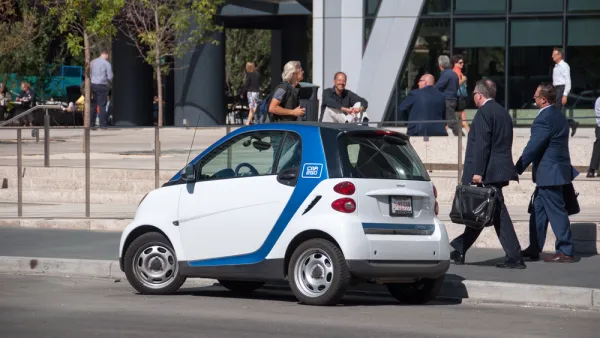
Arriving just in time in the District of Columbia, as Safe Track disrupts Metro service, General Motors launched 'Maven' to compete with ZipCar, Car2Go, and Enterprise car sharing services.


"Maven, a car-sharing service launched by General Motors, open[ed] for business Monday [July 18] in the District offering 40 vehicles in 10 lots scattered throughout the city," reports Lori Aratani in the Dr. Gridlock column for The Washington Post.
The company hopes to distinguish itself from other players in the market by offering “new vehicles with high trim levels.” The OnStar suite of services, which includes keyless entry, also will be available for users free of charge.
"To be honest, though, it sounds a whole lot like the other roundtrip car-sharing services available locally—except with fewer cars and parking spots," writes Rachel Sadon for DCist.
Zipcar, for example, has a fleet of more than 1,000 cars, and just added one-way trips around the region to boot. So is there any reason to give Maven a go?
With no membership fee, is there any reason not to? And rates are competitive, adds Sadon.
Prices for Maven start at $8 an hour for compact cars, like the Spark [and VOLT], to $14 for premium cars like the Cadillac ATS and standard SUVs like the GMC Yukon, up to $24 for the Escalade. Zipcar's rates start at $8 an hour, while Enterprise's start at $5.
More importantly, all car-sharing services may be in demand to fill the gaps left by SafeTrack reductions in service as D.C. Metro tries to "accelerate three years' worth of work into approximately one year," according to Metro.
Platform for self-driving cars?
Wired has speculated that the roll-out of Maven—which started in Ann Arbor and has since also expanded to Boston and Chicago—is actually just the foundation for the driverless future that GM plans to build.
As one entrant into the industry emerges, one departs
Bay Area-based FlightCar will be shutting down, reports Austin Walsh for the Daily Journal on July 19. FlightCar appeared to offer a unique service, more part of the sharing economy than their competitors.
The FlightCar business model was built around facilitating travelers renting their cars to others while they were out of town. Those who used the site’s services would receive a share of the rental proceeds, a free lift to the airport and a car wash.
However, all is not lost.
The essence of the FlightCar will live on though, as the technology platform has been sold to Mercedes-Benz Research & Development North America [see October post], and will be used to beef up the luxury car brand’s innovation lab for new services, according to [their] announcement.
Mercedes-Benz already owns car-sharing company Car2Go. In April, BMW launched ReachNow in Seattle, modeled on Car2Go.
Hat tip to POLITICO Morning Transportation.
FULL STORY: GM launches new car-sharing service in D.C.

Good News on Car Sharing
Car sharing networks that allow the vehicle to be returned to any location were found to have the impact of removing seven cars for each rented car in San Diego in a three-year study released July 19.

Mercedes-Benz Bets on a Suburban Future
From a new Silicon Valley facility, Mercedes' R&D department is developing car-share services based on a vision of 21st-century suburbs. The company is also testing self-driving prototypes and electric models.
To Serve a Growing Market, Car-Share Goes Custom
Stephanie Steinberg and Bill Vlasic survey the growing universe of car-sharing services. From big corporations to non-profits, the high demand for car sharing in urban areas allows a variety of alternatives to "coexist comfortably."

The state-sanctioned urbicide of Austin
People don’t kill cities. Freeways do.

US to reduce Colorado River water deliveries to Mexico
A new Colorado Treaty amendment reduces Mexico’s Colorado River water allocation by 250,000 acre feet.

New Jersey’s second-largest city bans standalone data centers
Jersey City will continue to allow co-location facilities, such as those meant for research institutions that store their own data.

Amtrak not solely to blame for New Jersey commuter rail's unreliability, report finds
A new study from the Garden State Initiative found that NJ Transit’s budget grew 20% across a 4 year period, but reliability declined significantly over the same period.

EPA erases limits on planet-warming pollution from power plants
Under Monday’s plan, power plants would still have some limits on how much mercury, arsenic and other contaminants they can emit.

Phoenix announces new on-demand transit service, more frequent RAPID buses
Both new services will launch in October, and are part of Phoenix's Project Effective Access Solutions for Easing Congestion.

FREE Course: Walkable City 1: Why Walkability?
After describing his path towards focusing on walkability as the essence of good planning, Jeff Speck marches through his five principal reasons for making more walkable places.
Reinventing Malls: Planning Alchemy—Turning Gray Fields Into Gold
The course focuses on the opportunities and imperatives that shape reinvention of mall sites.

Eagle County Government
Harvard University Graduate School of Design
Nashville Planning Department
The Architects Foundation
University of Cincinnati Online
The Pocatello Development Authority
The Urban Renewal Agency of the City of Pocatello
Journal of the American Planning Association