Americans have shown a clear preference for larger homes—even at the expense of the coveted backyard.


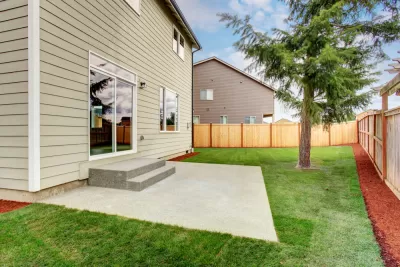
"The Yard — once the birthright of suburban American families with two kids, a dog, and a station wagon — is more endangered than ever," according to a feature article by Keith O'Brien.
Th article begins with a detailed anecdote about the home of Scott Nguyen, who has repeatedly expanded the square footage of his home, and of the paved surfaces outside it, in Winchester, Massachusetts. Nguyen's neighbors responded to the modifications by appealing to the city's zoning board, which then declared the new yard a "parking lot," and called for its removal. Nguyen has sued the board in Middlesex Superior Court.
After telling that story, O'Brien turns to the trend exemplified by Nguyen's story around the country:
According to US Census data, the size of new American homes has been climbing steadily for the past 15 years — up about 21 percent, to more than 2,500 square feet of indoor living space.
Meanwhile outdoor space has been shrinking:
The typical lot of a new home sold in this country is about 400 square feet smaller today than it was just five years ago.
The article includes details about the municipalities where the battles over teardowns have played out in Massachusetts, as well as the developers making the market-driven decisions affecting the built environment. O'Brien also considers the consequences of these building trends on the residents of the United States.
Read the full story: The incredible shrinking American yard

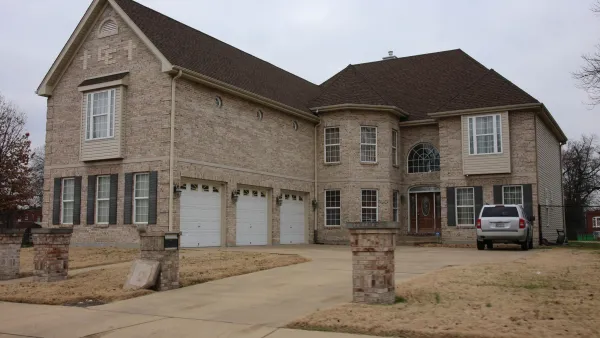
Behind America's Fixation on Big Houses
McMansion or not, the American home is a good 600 to 800 square feet larger than the average in most other countries. Possible reasons run the gamut from policy to culture to personal economics.

Study: House Sizes Increase at the Expense of Tree Canopies
A research study has found that increasing house sizes in the Los Angeles area have drastically reduced the number of trees shading the region's landscapes—regardless of geographic location of socioeconomic status.
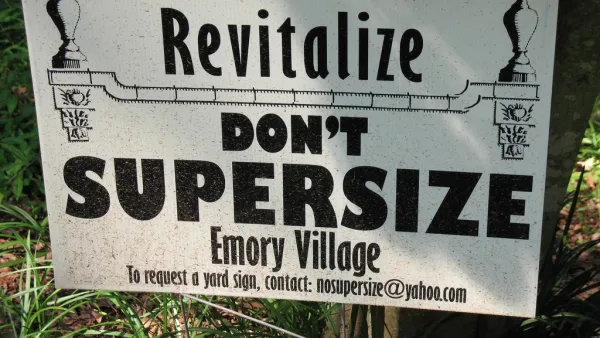
Economic Growth without the McMansions—Is America Ready?
Henry Grabar beckons the death of the McMansion, calling it an "American embarrassment" with no easy solution for planners.

Planetizen Federal Action Tracker
A weekly monitor of how Trump’s orders and actions are impacting planners and planning in America.

California plans to bury El Niño’s downpour
If the state plays its cards right, it may be able to store a billion acre-feet of El Niño’s water in aquifers.

Chicago breaks ground on $3 billion megadevelopment
The new neighborhood, titled Foundry Park, will one day host 3,700 residences.

California High-Speed Rail Authority CEO resigns after $600,000 scandal
Under Ian Choudri, the authority used taxpayer dollars to fund first class flights and trips to nightclubs.

Want to study the Missouri River? Soon, you may need unanimous approval from 10 states
Legislation would require 10 governors’ permission to study or build projects moving water outside the basin.

Desperate measures: Advocates weigh draining Lake Powell to fill Colorado River
Draining the reservoir could reduce evaporation losses by a couple hundred thousand acre-feet.

FREE Course: Walkable City 1: Why Walkability?
After describing his path towards focusing on walkability as the essence of good planning, Jeff Speck marches through his five principal reasons for making more walkable places.
Reinventing Malls: Planning Alchemy—Turning Gray Fields Into Gold
The course focuses on the opportunities and imperatives that shape reinvention of mall sites.

City of Rosemead
Rutgers University, Edward J. Bloustein School of Planning and Public Policy
One Hundred Miles
Hunter College, City University of New York (CUNY)
The Architects Foundation
University of Cincinnati Online
City of Cambridge
Montrose County
The Pocatello Development Authority