A pilot project combining the brain power and political will of the Detroit’s water department, Land Bank Authority, and the University of Michigan recently completed the first of four vacant lots into beautiful and functional bioretention gardens.


"Detroit’s water department and Land Bank Authority as well as the University of Michigan turned four vacant city lots into gardens designed to corral stormwater," according to an article by Charles E. Ramirez and Christine Ferretti.
Participants in the pilot project gathered in May to celebrate the opening of the one of the new lots, located on Evergreen, between Joy and Tireman in the Cody Rougeneighborhood on the west side of Detroit.
The bioretention gardens "capture and soak up storm runoff as well as beautify the area," according to the article. One local resident noted that the new garden is a vast improvement over the vacant home that stood on the lot before. Water officials expect each garden to reduce local runoff to stormwater sewers by 300,00 gallons.
More information on the pilot project, as well as the participation of the University of Michigan's School of Natural resources and Environment can be found in the video below.
FULL STORY: Sites of demolished Detroit homes used to soak up water

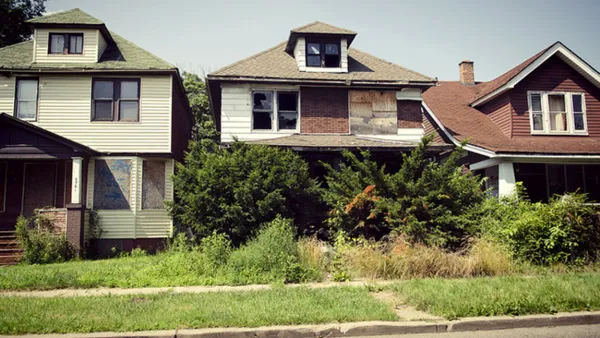
Detroit Residents Find it Hard to Access Land Bank Properties
Longtime residents say the city is not fulfilling its goal of keeping vacant parcels in the hands of locals as property values rise steeply.
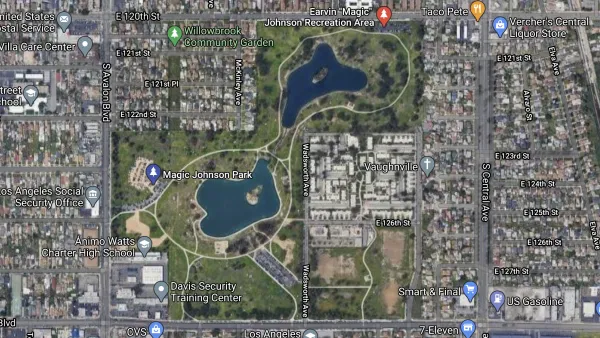
South Los Angeles Park Offers Hidden Benefits
Not only does the redevelopment of a large section of Earvin Magic Johnson Park in Willowbrook offer much needed green space and new amenities, it also helps to conserve water and improve water quality.

$160 Million in Bond Funding for Demolitions on the Ballot in Detroit
Proposal N, on the ballot for Detroit voters next week, will provide $160 million in bond funding for demolitions and $90 million to mothball homes for future rehab, but, according to this opinion, it won't solve the city's blight challenges.

Planetizen Federal Action Tracker
A weekly monitor of how Trump’s orders and actions are impacting planners and planning in America.

The state-sanctioned urbicide of Austin
People don’t kill cities. Freeways do.

US to reduce Colorado River water deliveries to Mexico
A new Colorado Treaty amendment reduces Mexico’s Colorado River water allocation by 250,000 acre feet.

5 New England states march closer to 800 megawatt wind energy project
Securing federal approval for the project may be complicated under the Trump administration, which has historically been hostile towards domestic wind power.

Baltimore to break ground on $50 million Transit Priority Project
The project will bring faster bus trips, safer streets and better bike connections to Baltimore.

Airbnb launches $250 million 'last-dollar financing' housing accelerator, makes first investment in Austin
The company will put $6.4 million towards affordable housing development in Texas’ capital.

FREE Course: Walkable City 1: Why Walkability?
After describing his path towards focusing on walkability as the essence of good planning, Jeff Speck marches through his five principal reasons for making more walkable places.
Reinventing Malls: Planning Alchemy—Turning Gray Fields Into Gold
The course focuses on the opportunities and imperatives that shape reinvention of mall sites.

Eagle County Government
Harvard University Graduate School of Design
Nashville Planning Department
The Architects Foundation
University of Cincinnati Online
The Pocatello Development Authority
The Urban Renewal Agency of the City of Pocatello
Journal of the American Planning Association