NextCity surveys a variety of new data-collecting technologies meant to clarify the impacts of bike and pedestrian infrastructure projects.



Bike advocates rely on the Census Bureau's American Community Survey to measure demographics and trends in urban cycling. But local conclusions drawn from that big-picture data can be misleading, Next City reports, and more precise strategies are in the works—including "bike-counter totems, GPS-enabled smartphone apps and cameras that use machine learning."
One piece of hardware, Numina, can count the users of a piece of infrastructure and discern patterns in their behavior. It uses a camera programmed to recognize and count moving parts like cyclists or pedestrians.
Others, like Strava and MapMyRide, can track bike routes via GPS and smartphone apps, as well as users' demographic data.
Each approach has its advantages and shortcomings, but advocates hope that together they can contribute to a more robust understanding of the impacts of complete streets infrastructure.
Read the full story: More Accurate Bicycle Counter Could Give Complete Streets Advocates a Boost

Rochester to Update Bicycle Master Plan with More Multimodal Infrastructure
The new active transportation plan will amend the existing bicycle master plan to include additional safety improvements for pedestrians and other multimodal road users.
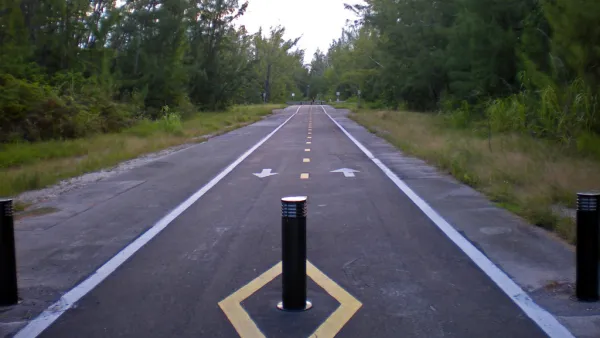
New Bikeways Coming to Atlanta This Year
Several new bike projects in the Atlanta area are slated to begin construction this year.
Bay Area Leads the Nation in Reducing Solo Commuters
According to the Census Bureau's American Community Survey on commuting to work, one subregion in the Bay Area can claim accolades for having achieved the largest drop in solo-commuting from 2006, scoring the third lowest drive-alone rate in 2013.

Desperate measures: Advocates weigh draining Lake Powell to fill Colorado River
Draining the reservoir could reduce evaporation losses by a couple hundred thousand acre-feet.

Eastern Nebraska is running out of electricity
Data centers and electrification are straining eastern Nebraska’s grid, throttling economic development.

Move over, LA: St. Louis gears up for Olympics, invests millions in downtown redevelopment
The Missouri city will host the 2028 Olympic soccer group stage and knockout matches.

‘No clear next steps’ for Chicago's permanent festival grounds
Eleventh Ward Ald. Nicole Lee has suggested Soldier Field as a possible location for the permanent event space.

California, Hawaii, Rhode Island approve housing propositions
Hawaii and Rhode Island each approved their sole proposition, while California approved two of its three.

Officials claim feds 'rushed' Amtrak environmental review
Amtrak plans to move their Chicago maintenance facility from an industrial area to a residential one.

FREE Course: Walkable City 1: Why Walkability?
After describing his path towards focusing on walkability as the essence of good planning, Jeff Speck marches through his five principal reasons for making more walkable places.
Reinventing Malls: Planning Alchemy—Turning Gray Fields Into Gold
The course focuses on the opportunities and imperatives that shape reinvention of mall sites.

City of Rosemead
Rutgers University, Edward J. Bloustein School of Planning and Public Policy
One Hundred Miles
University of Michigan School for Environment and Sustainability (SEAS)
Hunter College, City University of New York (CUNY)
The Architects Foundation
City of Cambridge
Montrose County
The Pocatello Development Authority