The state of Texas is expected to double its population between 2010 and 2050. Just how, though, is worthy of more scrutiny.


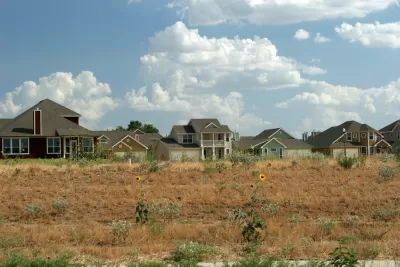
According to an article by Jill Cowan, "while Texas’ largest cities continued to add tens of thousands of residents last year, it’s the suburbs that are seeing the most marked transformation."
The article quotes Steve Murdock, former head of the U.S. census and current director of the Hobby Center for the Study of Texas at Rice University, who describes the story of Texas' population growth as a story of the I-35 corridor: "You start at the Oklahoma border, then there’s a few miles in between before you hit the suburbs of Dallas … through Waco to the Austin suburbs that now run really with no gaps between Austin and San Antonio."
The article digs into the demographic details of the state's growth, as well as a hidden fact among the typical Texas narratives: more than a quarter of the state's cities decline din population in the first five years of this decade. Most "are in rural areas hit hard by consolidation in the agriculture industry," according to Cowan.
Read the full story: Texas suburbs bursting with new residents; see how much they’ve grown

Household Sizes Growing in the U.S. for the First Time in 160 Years
This decade is likely to produce demographic news that will shock anyone born after 1850.

Google's Second Headquarters and the Future of San Jose
Amazon isn't the only tech giant building a second headquarters. Google's new offices could change the way companies interact with cities for the better, if they want to.
Atlanta's Dwindling Supply of Affordable Housing Units
Analysis shows that Atlanta is building a lot of new rental units, but most are priced at luxury levels, while the city's supply of low cost rental units are shrinking in the neighborhoods they're needed most.

Planetizen Federal Action Tracker
A weekly monitor of how Trump’s orders and actions are impacting planners and planning in America.

California plans to bury El Niño’s downpour
If the state plays its cards right, it may be able to store a billion acre-feet of El Niño’s water in aquifers.

Chicago breaks ground on $3 billion megadevelopment
The new neighborhood, titled Foundry Park, will one day host 3,700 residences.

Satanic place names
From streams and lakes to valleys and canyons, I mapped more than 1,000 places named after the Devil.

California High-Speed Rail Authority CEO resigns after $600,000 scandal
Under Ian Choudri, the authority used taxpayer dollars to fund first class flights and trips to nightclubs.

Want to study the Missouri River? Soon, you may need unanimous approval from 10 states
Legislation would require 10 governors’ permission to study or build projects moving water outside the basin.

FREE Course: Walkable City 1: Why Walkability?
After describing his path towards focusing on walkability as the essence of good planning, Jeff Speck marches through his five principal reasons for making more walkable places.
Reinventing Malls: Planning Alchemy—Turning Gray Fields Into Gold
The course focuses on the opportunities and imperatives that shape reinvention of mall sites.

City of Rosemead
Rutgers University, Edward J. Bloustein School of Planning and Public Policy
One Hundred Miles
Hunter College, City University of New York (CUNY)
The Architects Foundation
University of Cincinnati Online
City of Cambridge
Montrose County
The Pocatello Development Authority