In October 2014, Los Angeles Mayor Eric Garcetti acted to make the city more resilient from drought and climate change. In 2016, we get an update from leaders Gary Hildebrand and Marty Adams on L.A.'s stormwater capture systems.


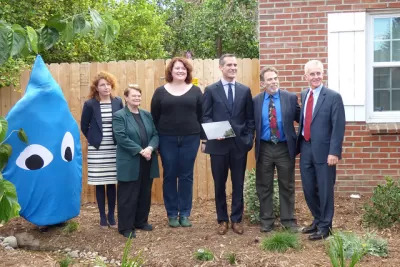
The evolution of water management in Los Angeles has expedited recently, as climate change and the historic drought have spurred more collaboration and innovation. After Mayor Eric Garcetti called for a reduction in the L.A. Department of Water and Power's purchase of imported potable water by 50 percent by 2024 and the creation of an integrated water strategy that increases local water supplies and that improves water security in the context of climate change and seismic vulnerability, leaders got to work. Gary Hildebrand, deputy director at the Los Angeles County Department of Public Works, and Marty Adams, director at the Los Angeles Department of Water and Power, join The Planning Report to explain advancements in their fruitful collaboration between city and county on stormwater capture.
Stormwater capture is a strategy that has received renewed attention as Los Angeles strives to shift to a fully local water supply. Hildebrand and Adams, veteran water officers, explain the impact of state and local drought action on their work and update The Planning Report on their ongoing projects, including the 2015 Stormwater Capture Master Plan and Rory Shaw Wetlands.
They describe a shift in focus from large-scale regional infrastructure to distributed projects that repurpose public and private lands—inspired by innovative conservation techniques worldwide. Marty Adams shares LADWP's progress, stating:
“LADWP now has a pilot program with LA County, TreePeople, and LA Sanitation for a smart-cistern setup where stormwater is be collected in a cistern on someone’s property… and then prior to it raining, the water in the cistern would be released to soak into the ground and make that volume available to capture the next storm as well.” With summer months approaching and the lack of an impactful El Nino, the water leaders share their vision for LA’s water future.
Both leaders agree that the mayor's action has helped accelerate a number of projects, including enhancements to the Pacoima and Tujunga spreading grounds. Even though the drought has had crippling impacts, they both believe that it has made everyone realize that Los Angeles has a good untapped resource in stormwater capture, which needs significant further investment.
Read the full story: Metro LA’s Water Supply Increasingly Relying on Management of Stormwater

Southern California's Water Conservation and Storage Efforts Paying Off
The region has poured over a billion dollars into storage infrastructure and demand management policies in anticipation of worsening drought conditions.
Los Angeles County Looking for Ways to Fund Stormwater Management
Supervisor Sheila Kuehl made the announcement at the recent VerdeXchange Conference.

Report Finds Weak Spots in the Los Angeles Water Grid
A "water atlas" compiled by UCLA's Luskin Center for Innovation reveals the patchwork that is Los Angeles' water supply system. Neighborhoods reliant on small providers and groundwater sources may be vulnerable.

Planetizen Federal Action Tracker
A weekly monitor of how Trump’s orders and actions are impacting planners and planning in America.

California plans to bury El Niño’s downpour
If the state plays its cards right, it may be able to store a billion acre-feet of El Niño’s water in aquifers.

Chicago breaks ground on $3 billion megadevelopment
The new neighborhood, titled Foundry Park, will one day host 3,700 residences.

Satanic Place Names
From streams and lakes to valleys and canyons, I mapped more than 1,000 places named after the Devil.

California High-Speed Rail Authority CEO resigns after $600,000 scandal
Under Ian Choudri, the authority used taxpayer dollars to fund first class flights and trips to nightclubs.

Want to study the Missouri River? Soon, you may need unanimous approval from 10 states
Legislation would require 10 governors’ permission to study or build projects moving water outside the basin.

FREE Course: Walkable City 1: Why Walkability?
After describing his path towards focusing on walkability as the essence of good planning, Jeff Speck marches through his five principal reasons for making more walkable places.
Reinventing Malls: Planning Alchemy—Turning Gray Fields Into Gold
The course focuses on the opportunities and imperatives that shape reinvention of mall sites.

City of Rosemead
Rutgers University, Edward J. Bloustein School of Planning and Public Policy
One Hundred Miles
Hunter College, City University of New York (CUNY)
The Architects Foundation
University of Cincinnati Online
City of Cambridge
Montrose County
The Pocatello Development Authority