Following the example of much newer corporations in Silicon Valley, the Ford Motor Company is planning a $9 billion new campus in Dearborn, to be built over ten years.


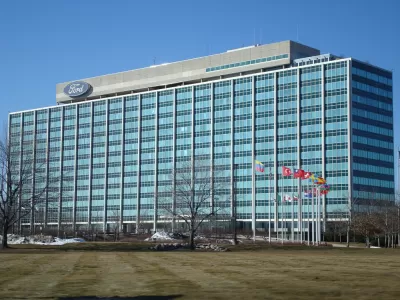
American auto companies haven't exactly had an easy few decades, but Detroit stalwarts like Ford and G.M. are making a comeback. To cement its hoped-for future as a 21st-century "mobility company," Ford is planning a monumental new campus in Dearborn, Michigan, based clearly on the Silicon Valley model.
Neal E. Boudette writes, "The company, which is 112 years old, said it would begin transforming its headquarters and main development center in Dearborn, just outside Detroit, into two sprawling, high-tech campuses of energy-efficient buildings. There, it plans to showcase autonomous shuttles, electric bikes and other green modes of transportation."
To compete with newer tech firms, car manufacturers are scrambling to re-brand themselves. "The headquarters plan reflects a broader struggle by automakers to shed their Rust Belt images and recast themselves as nimble, high-growth companies, said Akshay Anand, an analyst at with the research firm Kelley Blue Book."
That trend also applies to another one of the "Big Three" American automakers, General Motors. From the article: "Other automakers are moving in the same direction. General Motors recently invested $500 million in Lyft, the ride-sharing service and main rival of Uber. G.M. also acquired Cruise Automation, a maker of sensors and other gear that can enable conventional automobiles to drive themselves on highways."
Read the full story: Ford’s Planned New Headquarters Borrow Some Silicon Valley Sheen
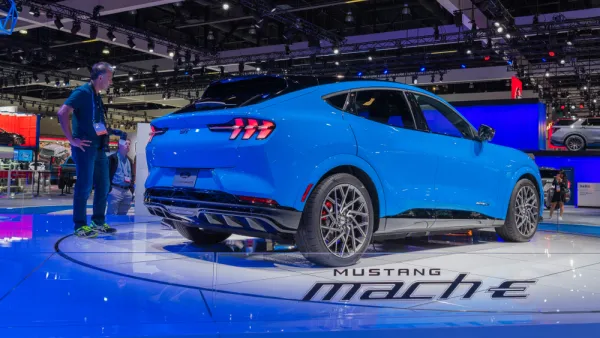
Ford Wants to Be First in the Affordable Electric Vehicle Market
The latest wave of popular electric vehicles, think Teslas and GMC Hummer EVs, are well outside of the price range of normal, thrifty Americans. Ford wants to change that.

GM's Electric Vehicle Future Arrives Early in Detroit-Hamtramck
GM's first non-internal combustion engine vehicle assembly plant will be in the form of 35-year-old plant straddling the Detroit-Hamtramck border thanks in part to a $2.27 billion state tax credit. Electric pickups, SUVs, and AVs will be produced.

Ford Planning Residential Units in its Detroit Train Station Adaptive Reuse
Ford will treat the Michigan Central Depot to a mixed-use adaptation.

Planetizen Federal Action Tracker
A weekly monitor of how Trump’s orders and actions are impacting planners and planning in America.

California plans to bury El Niño’s downpour
If the state plays its cards right, it may be able to store a billion acre-feet of El Niño’s water in aquifers.

Desperate measures: Advocates weigh draining Lake Powell to fill Colorado River
Draining the reservoir could reduce evaporation losses by a couple hundred thousand acre-feet.

Housing is the top priority of Seattle’s sole new councilmember
Jenks campaigned on building 1,000 new units of affordable housing.

New tax cuts may slash $1.5 billion in funding for Miami transit, public parks
Amendment 3 will save Miami-Dade homeowners $2,700 in 2028.

Arizona, Wisconsin, Pennsylvania hope to finally advance climate goals post-midterms
The three states have spent years under Republican or divided control.

FREE Course: Walkable City 1: Why Walkability?
After describing his path towards focusing on walkability as the essence of good planning, Jeff Speck marches through his five principal reasons for making more walkable places.
Reinventing Malls: Planning Alchemy—Turning Gray Fields Into Gold
The course focuses on the opportunities and imperatives that shape reinvention of mall sites.

City of Rosemead
Rutgers University, Edward J. Bloustein School of Planning and Public Policy
One Hundred Miles
University of Michigan School for Environment and Sustainability (SEAS)
Hunter College, City University of New York (CUNY)
The Architects Foundation
City of Cambridge
Montrose County
The Pocatello Development Authority