Seattle's 12th Avenue park offers a prototype for future urban parks. It is compact, doesn't require buying a lot of costly land, and can accommodate neighborhood scale events and programs


Seattle architect and planner Mark Hinshaw writes in Crosscut about a new Seattle park that meets the needs of an urban environment, one that can be used as an active place rather than the more traditional green space.
Writes Hinshaw:
12th Avenue Square is a new kind of open space that we are beginning to appreciate — one not necessarily defined by flora and fauna, topography or hydrology. We also want spaces that are active, energized, filled with people and may include expressions of art. This type of space often involves no vegetation at all, but rather sets up a literal stage where people and performances change all the time. In a sense, we are finally learning to emulate the lively urban spaces in European cities.
Read the full story: No room for trees in Seattle’s new parks
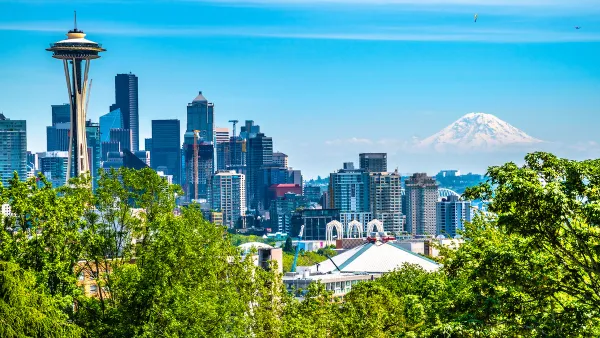
Seattle to Host 2024 Urban Parks Conference
In June 2024, City Parks Alliance, in partnership with Seattle Parks and Recreation, will hold the Greater & Greener conference, which will include a mix of indoor sessions and outdoor experiences focusing on urban parks.
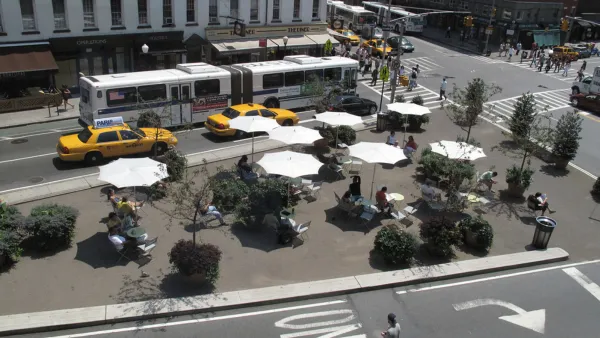
Pavement Parks: a Better Parklet Alternative
Too often, street-side parklets become little more than semi-private patios for the businesses that sponsor them. Pavement parks, replacing dangerous intersections, may be a more worthwhile option.
Improvisation Under the Freeway
A spectacular series of recent photos from Seattle's Colonnade Park built beneath highway I-5 tell the story of adapted urban space.

Planetizen Federal Action Tracker
A weekly monitor of how Trump’s orders and actions are impacting planners and planning in America.

California plans to bury El Niño’s downpour
If the state plays its cards right, it may be able to store a billion acre-feet of El Niño’s water in aquifers.

Desperate measures: Advocates weigh draining Lake Powell to fill Colorado River
Draining the reservoir could reduce evaporation losses by a couple hundred thousand acre-feet.

Mamdani’s pied-à-terre tax survives legal challenge
A panel of judges found that the plaintiffs failed to demonstrate injury as a result of New York City's implementation of the tax.

Eastern Nebraska is running out of electricity
Data centers and electrification are straining eastern Nebraska’s grid, throttling economic development.

Seattle passes record-breaking transit services expansion
Proposition 1 will double the city’s transit tax to add 95,000 more bus trips and preserve 180,000 bus trips annually.

FREE Course: Walkable City 1: Why Walkability?
After describing his path towards focusing on walkability as the essence of good planning, Jeff Speck marches through his five principal reasons for making more walkable places.
Reinventing Malls: Planning Alchemy—Turning Gray Fields Into Gold
The course focuses on the opportunities and imperatives that shape reinvention of mall sites.

City of Rosemead
Rutgers University, Edward J. Bloustein School of Planning and Public Policy
One Hundred Miles
University of Michigan School for Environment and Sustainability (SEAS)
Hunter College, City University of New York (CUNY)
The Architects Foundation
City of Cambridge
Montrose County
The Pocatello Development Authority