An art installation called "The Back 9" is planned for Los Angeles' Skid Row to tackle the issues of gentrification, zoning, and back room deals for development rights.


The opening paragraph of an article by Linda Poon has to be read for itself and then probably reread to let it sink in:
Los Angeles’ newest miniature golf course will not be like any other. Instead of safari-themed obstacle courses, this one will feature edifices that address the city’s zoning issues. Oh, and it will sit right inside Skid Row, a neighborhood that has the densest concentration of homeless people in the country.
Educational artist Rosten Woo and the Los Angeles Poverty Department (LAPD) collaborated on the project, which is planned for exhibition at the Skid Row Museum in 2017. The installation received a $50,000 grant from the Mike Kelley Foundation, according to Poon.
Poon quotes John Malpede, founder and artistic director of LAPD, to describe the ideas behind "The Back 9," as the installation is called. The name refers to the golf format of the installation as well as the use of that term to describe clandestine conversations.
It’s a fitting name, Malpede says, because the project is all about transparency. “Are [zoning] decisions going to be made ‘on the back 9,’ or are they going to happen in a public process in which [decisions] aren’t predetermined by the time they’re public?”
Read the full story: L.A. Is Putting a Mini-Golf Course on Skid Row
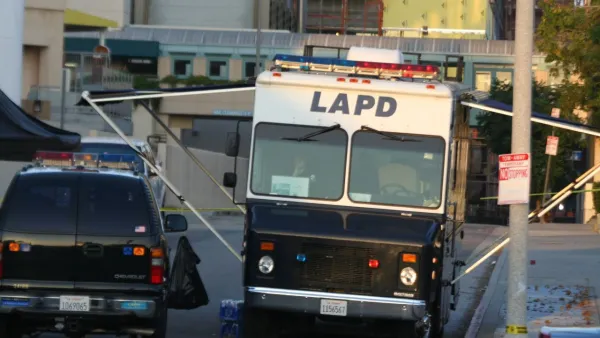
Still Gritty: Crime Wave in Downtown Los Angeles
As people and jobs stream into the district, downtown's long-simmering problems butt up against vigorous urban renewal. Crime is up, but so are property values.
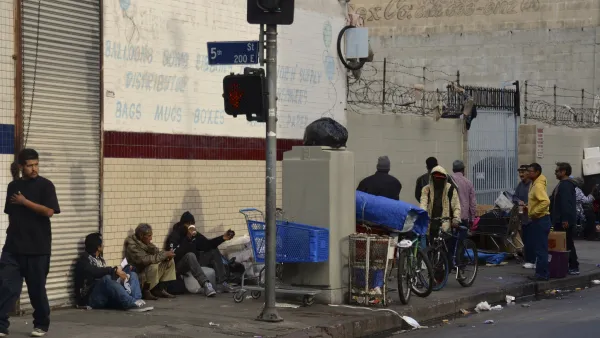
Conflicting Stories From Los Angeles' Skid Row
As the city considers new ordinances making it easier for police to break up homeless camps, residents say forced displacement is already underway. Police deny an increase in homeless sweeps.
Residents Disillusioned with the Planning Process in Los Angeles' Chinatown
Sharon McNary reports on a proposed development in the Chinatown neighborhood of Los Angeles that predates, and could thus avoid, the guidelines put forward by one of the most progressive plans in the city—the Cornfield Arroyo Specific Plan.

Planetizen Federal Action Tracker
A weekly monitor of how Trump’s orders and actions are impacting planners and planning in America.

California plans to bury El Niño’s downpour
If the state plays its cards right, it may be able to store a billion acre-feet of El Niño’s water in aquifers.

Desperate measures: Advocates weigh draining Lake Powell to fill Colorado River
Draining the reservoir could reduce evaporation losses by a couple hundred thousand acre-feet.

In Texas, data centers are swallowing promised parkland
Residents who moved to Taylor, Texas for a rural community now have to contend with three data centers in their backyard.

How a Chicago-sized wind farm beat the odds and powered on
The project spanned five presidential administrations and a standoff with a U.S. military base.

MTA gives itself 30 days to transform pit into basketball court
The site has been under construction since 2022; the city originally estimated it would finish the court in 2024.

FREE Course: Walkable City 1: Why Walkability?
After describing his path towards focusing on walkability as the essence of good planning, Jeff Speck marches through his five principal reasons for making more walkable places.
Reinventing Malls: Planning Alchemy—Turning Gray Fields Into Gold
The course focuses on the opportunities and imperatives that shape reinvention of mall sites.

City of Rosemead
Rutgers University, Edward J. Bloustein School of Planning and Public Policy
One Hundred Miles
Hunter College, City University of New York (CUNY)
The Architects Foundation
University of Cincinnati Online
City of Cambridge
Montrose County
The Pocatello Development Authority