Alphabet's Sidewalk Labs is readying a product called Flow to help cities and counties make the most of transportation data. The news is another step along the path to a future version of transportation.


Laura Bliss shares the big news about a project by Alphabet's (i.e., Google's) Sidewalk Labs to develop a product called Flow—"a digital platform that seeks to address the real-time transit problem and more."
Bliss explains in more detail how Flow works:
Flow will aggregate and analyze mobility data from a great number of sources—including Google Maps, Waze, municipal data, and eventually, remote traffic sensors—to identify what’s causing congestion and which areas need what kind of service.
Conor Dougherty provides additional coverage of Flow for The New York Times, including the revelation that Flow is a part of the $40 million Smart Cities Challenge, sponsored by the U.S. Department of Transportation. Dougherty also previews the look and feel of Flow along with additional details about how the product could roll out to the public.
Read the full story: Cities to Untangle Traffic Snarls, With Help From Alphabet Unit

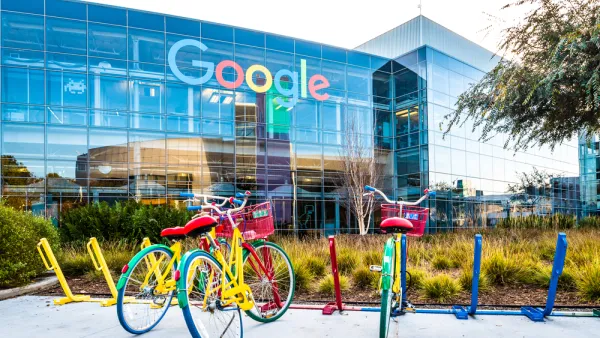
Google's Decade of Land Acquisition Cresting During the Pandemic
According to reports, Google parent company Alphabet is pulling back on two massive land acquisition deals amidst the economic uncertainty of the COVID-19 pandemic. A development approval setback will also slow the company's expansion.

Breaking News: Google to Spend $1 Billion on Housing in the Bay Area
The tech industry giant answers a call to do more to help alleviate housing prices in the region it calls home by promising to build tens of thousands of units on its own land.

Toronto's Quayside Will Be Plugged In, But the Risks for Residents Are Unclear
Technology will be part of everyday life in a new Toronto neighborhood, planned by Sidewalk Labs. But looking to the future is also raising a host of privacy concerns.

Planetizen Federal Action Tracker
A weekly monitor of how Trump’s orders and actions are impacting planners and planning in America.

Amtrak, CN end decades-long dispute with eight-year agreement
The new operating agreement establishes an updated framework for the companies to work together, including processes to resolve disputes.

Judges permit Denver to divert 77,000 acre feet from the Colorado River for reservoir expansion
Overuse and climate change have caused the Colorado River’s water levels to plummet.

Maryland local governments examine if they should have more power to raise property taxes
Maryland’s housing market is out of reach for the majority of moderate-income residents.

Northwest rail fans eager for Sept. 30 debut of Amtrak’s Airo fleet
Get ready for that new train smell and more seats. But they won’t go faster or run more frequently on the Cascades route in Washington and Oregon.

NYC DOT wants faster, more permanent street upgrades
The city is examining ways to build more concrete infrastructure without getting entangled in 'decades-long' projects.

FREE Course: Walkable City 1: Why Walkability?
After describing his path towards focusing on walkability as the essence of good planning, Jeff Speck marches through his five principal reasons for making more walkable places.
Reinventing Malls: Planning Alchemy—Turning Gray Fields Into Gold
The course focuses on the opportunities and imperatives that shape reinvention of mall sites.

Harvard University Graduate School of Design
KFH Group Inc.
Greater Baltimore Committee
The Architects Foundation
University of Cincinnati Online
The Pocatello Development Authority
The Urban Renewal Agency of the City of Pocatello