While the practice of flipping houses has not yet returned to its pre-recession levels, one city in particular, is climbing quickly back to peak levels: Las Vegas.


According to an article by Patrick Clark, the slow return of house flipping (i.e., buying buildings needing various levels of repair, fixing them up, and selling them at a profit shortly after) is finally picking up some momentum. Evidence Las Vegas, "where flipping is making a steady comeback."
Clark reports that "flips accounted for 10.4 percent of homes sales in the Las Vegas metropolitan area" during the third quarter of the 2015. The Las Vegas percentage far outpaces the national average of 5 percent (which is still sluggish compared to the pre-recessionary rate of 8.6 percent set in 2006). The Las Vegas flip rate is still down from a peak of 13.1 percent set in the third quarter of 2005, but along with Birmingham, Alabama, the city is clearly leading the nascent renaissance of house flipping. The data on house flipping is found in a report released last month by Trulia.
The article goes on to speculate about why the practice of house flipping is making its comeback in Las Vegas (hint: home prices in the region are low).
Read the full story: House Flipping Is Making a Comeback in Las Vegas
The 'Redacted Landscape' of the Las Vegas Fringe
Bldg Blog shares news of photographer Michael Light's new book "Black Mountain," which documents the "the construction and large-scale terrestrial formatting of a new housing development called Lake Las Vegas."
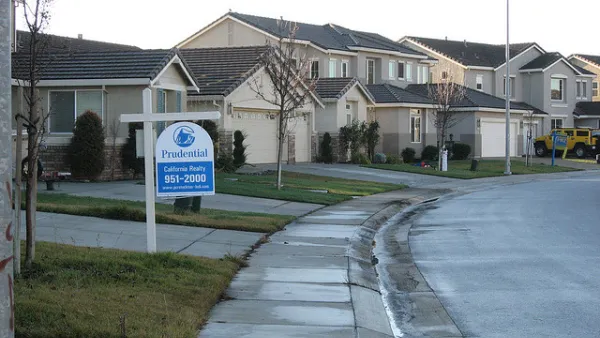
When Wall Street Controls the Housing Market
A debate about the effect of the increasing footprint of large, institutional investors in the housing market is further fragmenting the politics of development in the United States.
'The Great Real Estate Reset'
Business as usual in the real estate industry is failing the economy and the political and social cohesion of the United States, according to a new initiative launched by the Brookings Institution.

Planetizen Federal Action Tracker
A weekly monitor of how Trump’s orders and actions are impacting planners and planning in America.

Eastern Nebraska is running out of electricity
Data centers and electrification are straining eastern Nebraska’s grid, throttling economic development.

Move over, LA: St. Louis gears up for Olympics, invests millions in downtown redevelopment
The Missouri city will host the 2028 Olympic soccer group stage and knockout matches.

Dallas releases zoning code overhaul to officials
The drafted overhaul is over 400 pages long.

NYC renovations for dangerous, ‘mercilessly crammed’ street delayed until 2027
Construction was supposed to begin this fall.

San Diego’s Midway Rising project gets greenlight from city council
The project looks to become the largest affordable housing development in California's history.

FREE Course: Walkable City 1: Why Walkability?
After describing his path towards focusing on walkability as the essence of good planning, Jeff Speck marches through his five principal reasons for making more walkable places.
Reinventing Malls: Planning Alchemy—Turning Gray Fields Into Gold
The course focuses on the opportunities and imperatives that shape reinvention of mall sites.

City of Rosemead
Rutgers University, Edward J. Bloustein School of Planning and Public Policy
One Hundred Miles
University of Michigan School for Environment and Sustainability (SEAS)
Hunter College, City University of New York (CUNY)
The Architects Foundation
City of Cambridge
The Pocatello Development Authority
The Urban Renewal Agency of the City of Pocatello