Looking for a greater awareness of social responsibility, the founder and editor-in-chief of The Architect's Newspaper calls for a new organization tasked with advocacy in New York City.


William Menking pens a withering critique both of the de Blasio Administration in and the state of design advocacy in the city. The editorial starts out by pulling no punches:
The New York architectural community’s relationship to Bill de Blasio’s mayoralty is a complicated one. Not only does the mayor not understand or value the contributions that design and architecture can make to the quality of everyday life, but he also turns his back on many of the positive contributions the Bloomberg administration made in that realm.
But Menking is also willing to blame that reality solely on Mayor de Blasio:
It is an open question and one worth asking: How much is the architecture community contributing to de Blasio’s perception that architecture is only for the wealthy and middle class?
The editorial provides a call to action to the New York design community to take the substantial effort they collectively devote to design research and refocus it toward design advocacy.
Read the full story: EDITORIAL> WHO SPEAKS FOR ARCHITECTS?
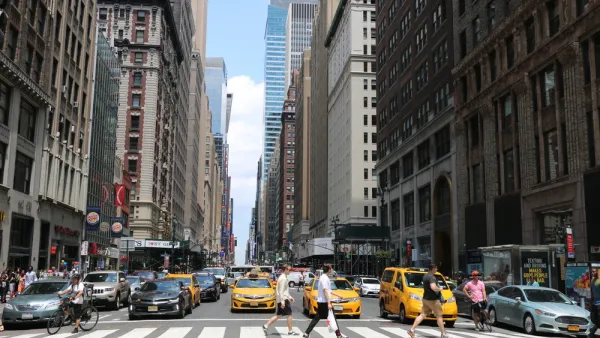
Praise for Gov. Andrew Cuomo from New York Times on Cordon Pricing
Thanks to the governor's support, there is reason for optimism that a plan to charge motorists entering Manhattan below 60th St. and toll the East River bridges will have a better outcome than Mayor Michael Bloomberg's plan did in April 2008.

“Skin, Like a City, Will Tell You if You’ve Ignored its History”
Once an urban planner, Sean Colgrave traded in infrastructure for ink when he became a tattoo artist. Now he says: one profession has a lot to learn from the other.

These Bear Safety Signs Illustrate the Impact of Good Design
What makes a sign effective?

Planetizen Federal Action Tracker
A weekly monitor of how Trump’s orders and actions are impacting planners and planning in America.

California plans to bury El Niño’s downpour
If the state plays its cards right, it may be able to store a billion acre-feet of El Niño’s water in aquifers.

Desperate measures: Advocates weigh draining Lake Powell to fill Colorado River
Draining the reservoir could reduce evaporation losses by a couple hundred thousand acre-feet.

Post election, Texas is no longer Musk’s 'AI oasis'
Elon Musk dolled out $446 million on the 2026 midterms, the most ever spent by a non-canidate.

Chicago voters approve permanent festival grounds, penalty for vacant property owners
Currently, major summer and fall festivals take over public parks for weeks at a time, drawing criticism from nearby residents

NYC votes to cut outdoor dining red tape, speed up permitting
New York City also voted to allow the Department of Transportation to begin work on urgent projects before notifying elected officials.

FREE Course: Walkable City 1: Why Walkability?
After describing his path towards focusing on walkability as the essence of good planning, Jeff Speck marches through his five principal reasons for making more walkable places.
Reinventing Malls: Planning Alchemy—Turning Gray Fields Into Gold
The course focuses on the opportunities and imperatives that shape reinvention of mall sites.

City of Rosemead
Rutgers University, Edward J. Bloustein School of Planning and Public Policy
One Hundred Miles
Hunter College, City University of New York (CUNY)
The Architects Foundation
University of Cincinnati Online
City of Cambridge
Montrose County
The Pocatello Development Authority