Scalia's death means that the Supreme Court is left with eight remaining judges. In the case of a tie vote, the decision from a lower court is upheld with some restrictions. A tie vote on the Clean Power Plan may be good news for the environment.


deh ofSupreme Court Jutice Antonin Scla [on Feb. 13]
Clean Power Plan's survival now rests with US Court of Appeals for the DC Circuit
"That case is being heard by a three-judge panel of the DC Circuit Court," writes Plumer. "Oral arguments begin June 2. A decision is expected by fall."
And the good news for the environment is that "(t)he Obama administration looks likely to prevail in this arena," adds Plumer, though by no means is it a certainty.
Irrespective of any type of judicial ruling on the Clean Power Plan, a Republican president in 2017 "could just scuttle the rule, either through administrative actions or by legislation," writes Plumer. And with the stroke of a pen, he could also retract Obama's signature on the international climate accord.
Hat tip to Loren Spiekerman.
Read the full story: What Antonin Scalia's death means for Obama's climate plans

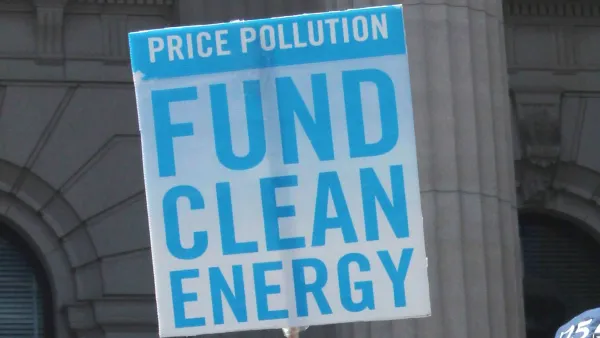
Clean Power Plan Showdown in U.S. Appeals Court on Tuesday
The Obama Administration's most powerful environmental initiative, the Clean Power Plan, was put on hold by the Supreme Court last February. It was heard by 10 judges of the U.S. Court of Appeals in Washington, D.C. on September 27.
Supreme Court Puts Obama's Key Climate Initiative on 'Hold'
In an unusual move that doesn't portend well for the EPA initiative, the Supreme Court ruled that the Clean Power Plan Rule that reduces emissions from existing power plants be suspended while it is heard by the Court of Appeals this summer.

Power Plants: A Win for the EPA
New rules from the US Environmental Protection Agency to regulate greenhouse gas emissions from fossil fuel-fired power plants survived an attempt by 25 Republican-led states to block their implementation while their case is litigated.

Planetizen Federal Action Tracker
A weekly monitor of how Trump’s orders and actions are impacting planners and planning in America.

Amtrak, CN end decades-long dispute with eight-year agreement
The new operating agreement establishes an updated framework for the companies to work together, including processes to resolve disputes.

Judges permit Denver to divert 77,000 acre feet from the Colorado River for reservoir expansion
Overuse and climate change have caused the Colorado River’s water levels to plummet.

Atlanta City Council unanimously backs $3.5 billion Beltline light rail project
The resolution was drafted after Atlanta Mayor Andre Dickens pulled support for the Atlanta Streetcar extension last year.

SEPTA to bring nearby frequent transit to over 1 million new riders as part of decade-long plan
The agency's Accelerate plan will also bring frequent transit to twice the amount of jobs that are currently located near it.

NYC plants over 18,000 trees, the most new foliage in a decade
Many of the trees were planted in communities vulnerable to extreme heat.

FREE Course: Walkable City 1: Why Walkability?
After describing his path towards focusing on walkability as the essence of good planning, Jeff Speck marches through his five principal reasons for making more walkable places.
Reinventing Malls: Planning Alchemy—Turning Gray Fields Into Gold
The course focuses on the opportunities and imperatives that shape reinvention of mall sites.

City of Thousand Oaks
City of Wisconsin Rapids
Harvard University Graduate School of Design
The Architects Foundation
University of Cincinnati Online
The Pocatello Development Authority
The Urban Renewal Agency of the City of Pocatello