While bikeshare is popular with planners and local officials all over the country, in some cities it still hasn't proven popular with people. One author has some thoughts on how bikeshare can begin to attract larger numbers.


Utpal Dholakia examines a potential antidote to the widespread resistance to public transit, in the era of automobile:
Against the backdrop of general malaise and stagnation, public bike-sharing programs feel like a breath of fresh air. These programs are popping up in one city after another across the United States.
The article provides explanation of bikesharing, for the uninitiated, and also provides several angles from which advocates and planners can start to build bikeshare systems that appeal to the masses both as a new form of transit and as an alternative to the automobile. For instance, one potentially appealing aspect of bikeshare is already in place, according to Dholakia: "Unlike other public transit methods, [Bikeshare] transfers control over getting from point A to point B back to the consumer."
The biggest impediment to bikeshare adoption, according to Dholakia, is the perception of bike safety. Dholakia lays out a gameplan to address the perception of safety on bikes, with more detail in the article: 1) provide clear explanations of risk, 2) target messages for people with different levels of comfort or concern, and 3) target locations for bikeshare where risk is relatively low.
Read the full story: How to Make Public Bike-Sharing More Popular

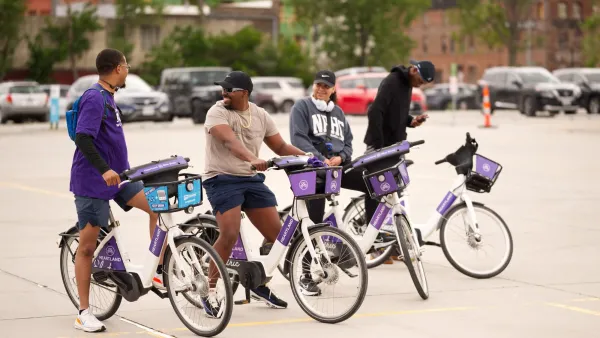
Omaha's 400 shared e-bikes are now free to all residents
Before eliminating fares for locals, the Heartland system only recovered 10%-15% of its operating costs through fare revenue.
Study: Metro Systems Cut Driving Significantly More Than Other Forms of Transit
European cities with subway systems have a much lower share of car trips than cities with tram- or bus-based transit systems.

DC Bike Share Growing Fast, But Regional Gaps Remain
The wildly popular system ‘frays at its geographic edges,’ making its use less effective outside the central District.

Planetizen Federal Action Tracker
A weekly monitor of how Trump’s orders and actions are impacting planners and planning in America.

Amtrak, CN end decades-long dispute with eight-year agreement
The new operating agreement establishes an updated framework for the companies to work together, including processes to resolve disputes.

Judges permit Denver to divert 77,000 acre feet from the Colorado River for reservoir expansion
Overuse and climate change have caused the Colorado River’s water levels to plummet.

South Chicago development proposal would 'upzone' neighborhoods to increase density
The South Chicago Land Use Framework plan also aims to promote pedestrian and transit-oriented developments.

Boston has spent millions making the Green Line more accessible — and there’s no end in sight
While the city has invested millions into expanding and adding platforms to the Green Line to make it more accessible, new train cars set to arrive next year will be too tall for disabled passengers to board without raising the current platforms.

Idaho may see an 18% drop in federal surface transit funding — the largest estimated cut in the US
Transit systems in rural communities are much more reliant on federal funding to provide their services.

FREE Course: Walkable City 1: Why Walkability?
After describing his path towards focusing on walkability as the essence of good planning, Jeff Speck marches through his five principal reasons for making more walkable places.
Reinventing Malls: Planning Alchemy—Turning Gray Fields Into Gold
The course focuses on the opportunities and imperatives that shape reinvention of mall sites.

City of Wisconsin Rapids
Harvard University Graduate School of Design
KFH Group Inc.
The Architects Foundation
University of Cincinnati Online
The Pocatello Development Authority
The Urban Renewal Agency of the City of Pocatello