The St. Louis City Council recently approved the initial steps for 1,800 acres of Maryland Heights floodplain. Plenty of hurdles remain, such as coming up with the money the developer wants to see the project through.


"A business partner of Los Angeles Rams owner Stan Kroenke is seeking to develop 1,800 acres of Maryland Heights flood plain into a vast retail, entertainment, office, residential and sports district," report David Hunn and Kristen Taketa. "The development would be one of the largest, if not the largest, mixed-use ones in the region," they add.
Alan Bornstein is the developer of the mixed-use project, which would redevelop a port of the city's riverfront flood plan that the city has been hoping to redevelop for a decade, without any developers willing to take on the project.
Bornstein is part of the team that infamously demanded tax incentives to keep the Rams NFL team in St. Louis. He's already gone on the record saying that the Maryland Heights project will require tax incentives and a public-private partnership to redevelop. The article includes more details about the size of the project, how it's size compares to others in the region, and what political hurdles might remain for the project to clear when final plans are complete.
Read the full story: Kroenke, partner want tax dollars for huge Maryland Heights development

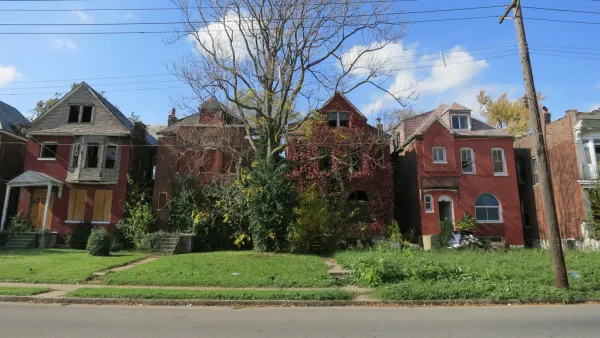
The Dark Side of the Rust Belt Revival
Cities in flyover country are facing new redevelopment challenges as companies relocate from costly coastal cities. In St. Louis, downtown revitalization has also brought plans to tackle blight, and the consequences for residents could be immense.
The Massive Redevelopment Plans for North St. Louis Failed—What Next?
Detroit has Dan Gilbert, and for a few years, it looked like St. Louis had Paul McKee. Now that McKee's massive plans for the redevelopment of North St. Louis have failed expectations, what has been lost and what, potentially, can still be gained?
Money, Options Pour into Pruitt-Igoe in St. Louis—Are They Any Good?
The long shadow of 20th century urban renewal strategies color the debate over three potential redevelopment proposals for the site of the former site of the Pruitt-Igoe public housing complex on St. Louis' Near North Side.

Planetizen Federal Action Tracker
A weekly monitor of how Trump’s orders and actions are impacting planners and planning in America.

Amtrak, CN end decades-long dispute with eight-year agreement
The new operating agreement establishes an updated framework for the companies to work together, including processes to resolve disputes.

Judges permit Denver to divert 77,000 acre feet from the Colorado River for reservoir expansion
Overuse and climate change have caused the Colorado River’s water levels to plummet.

Boston has spent millions making the Green Line more accessible — and there’s no end in sight
While the city has invested millions into expanding and adding platforms to the Green Line to make it more accessible, new train cars set to arrive next year will be too tall for disabled passengers to board without raising the current platforms.

Idaho may see an 18% drop in federal surface transit funding — the largest estimated cut in the US
Transit systems in rural communities are much more reliant on federal funding to provide their services.

How ‘post-disaster gentrification’ alters neighborhoods after natural calamities
After hurricanes, fires or other calamities, the original residents of a community are often replaced by younger, wealthier residents.

FREE Course: Walkable City 1: Why Walkability?
After describing his path towards focusing on walkability as the essence of good planning, Jeff Speck marches through his five principal reasons for making more walkable places.
Reinventing Malls: Planning Alchemy—Turning Gray Fields Into Gold
The course focuses on the opportunities and imperatives that shape reinvention of mall sites.

City of Wisconsin Rapids
Harvard University Graduate School of Design
KFH Group Inc.
The Architects Foundation
University of Cincinnati Online
The Pocatello Development Authority
The Urban Renewal Agency of the City of Pocatello