Patano Studio Architecture is doing double duty as advocate and concept designer for an idea called Seattle C.A.P.



Jen Kinney reports on the details behind an ambitious proposal for a cap park over the I-5 Freeway in Downtown Seattle. The article focuses on the work of Patano Studio Architecture to design and advocate for the so-called Seattle C.A.P. According to Kinney, the designers "see a park atop I-5 solving myriad problems at once: reconnect the severed urban fabric, reduce noise and air pollution, manage stormwater, and create some affordable housing."
Kinney shares renderings of the proposed park, which she describes as a river of trees. Also detailed is the potential for the park to actually be built. "Seattle’s DOT has been receptive, as have other city agencies," writes Kinney, "while the state DOT has generally dismissed the project on basis of further traffic congestion and cost (which Patano estimates at roughly $800 million)."
The Capitol Hill Seattle Blog also provided additional details about the growing support for the cap park plans in December, in connection with a proposed expansion of the adjacent convention center.

Read the full story: Seattle Architect Says the Time Is Right for This Highway-Capping Park Design
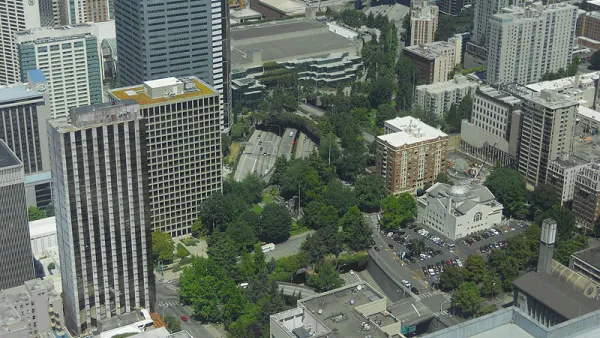
Seattle Plans Remodel of World’s First Freeway Cap Park
The Brutalist design by a famed landscape architect will be preserved, but not without better visibility and improved lighting.
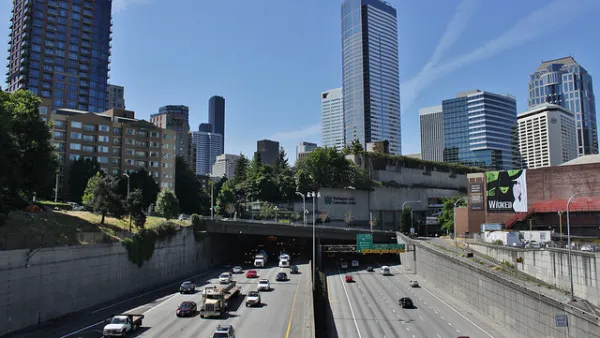
Seattle Residents Angling For New Cap Park Over I-5
As Seattle’s Convention Center expansion moves forward, community members want the public benefit discussion to focus on a new downtown park over I-5.

Housing is the top priority of Seattle’s sole new councilmember
Jenks campaigned on building 1,000 new units of affordable housing.

Planetizen Federal Action Tracker
A weekly monitor of how Trump’s orders and actions are impacting planners and planning in America.

California plans to bury El Niño’s downpour
If the state plays its cards right, it may be able to store a billion acre-feet of El Niño’s water in aquifers.

Desperate measures: Advocates weigh draining Lake Powell to fill Colorado River
Draining the reservoir could reduce evaporation losses by a couple hundred thousand acre-feet.

Housing is the top priority of Seattle’s sole new councilmember
Jenks campaigned on building 1,000 new units of affordable housing.

New tax cuts may slash $1.5 billion in funding for Miami transit, public parks
Amendment 3 will save Miami-Dade homeowners $2,700 in 2028.

Arizona, Wisconsin, Pennsylvania hope to finally advance climate goals post-midterms
The three states have spent years under Republican or divided control.

FREE Course: Walkable City 1: Why Walkability?
After describing his path towards focusing on walkability as the essence of good planning, Jeff Speck marches through his five principal reasons for making more walkable places.
Reinventing Malls: Planning Alchemy—Turning Gray Fields Into Gold
The course focuses on the opportunities and imperatives that shape reinvention of mall sites.

City of Rosemead
Rutgers University, Edward J. Bloustein School of Planning and Public Policy
One Hundred Miles
University of Michigan School for Environment and Sustainability (SEAS)
Hunter College, City University of New York (CUNY)
The Architects Foundation
City of Cambridge
Montrose County
The Pocatello Development Authority